↗ Live site
Preview: a read-only copy of the forum. To post or reply, use the current forum.

Orvonton and the Milky Way

106 posts · 10 participants · started May 31, 2015, 6:07 PM

  1. George wrote:

    “1)  In post #15175 you place Andromeda in the first outer space level. This…”

    George – thanks for alerting me to this potential confusion. I’ve updated that offending sketch to indicate that Andromeda (M31) is in that “relatively quiet zone” between the superuniverse beltway of emergent energies (the “present ragged edge of the grand universe” — 129.11, 12:1.13), and the first outer space level.

    “The relatively quiet zones between the space levels, such as the one separating the seven superuniverses from the first outer space level, are enormous elliptical regions of quiescent space activities.” (125.1, 11:7.7)

    For reference, here is the updated version (may need to refresh browser): http://www.ubron.org/groupphotos/MW_vs_M31_b.jpg

    (PS: to “lessen conceptual confusion” (469.2, 42:2.2) I’ve also removed figure 8, that “place-holder for the Maltese Cross” – see above.)

    William, you asked what are we to do about various inconsistencies. Recall that I began this adventure by referring to the comment in (101:4.2): “within a few short years many of our statements regarding the physical sciences will stand in need of revision”.

    I wrote:

    “I’m keen to get on with this revision. But if we’re going to revise the UB story, first we need to work out what that story is. Below is my attempt to describe what I understand this story to be, at least with regard to the seven superuniverses. Once we get this in place, we’ll have a target at which to start shooting holes.”

    What I’ve attempted so far is simply to describe, from a scientific perspective, the physical implications of a superuniverse beltway of emergent energies in motion about Paradise for at least a trillion years. To make contact with 21st century physics, I’ve used the action (“tidal effects”) of Weyl curvature upon an annular disk of ultimata to help partition, shape and ripen the distribution of gravita (“measurable matter”). Given the nature of orbital dynamics, this superuniverse distribution of gravita must be essentially flat. Please note, this says nothing about the shape of space itself, this is merely an observation about the distribution of measurable matter in the relatively tiny central kernel of a vast “master universe”.

    With this concept in place, let’s now think about which of those many “statements regarding the physical sciences will stand in need of revision“.

    For example, regarding the distance to Andromeda (M31), any modern astronomer reading “almost one million years ago” (170.1, 15:4.7) would simply read that as a quote from Edwin Hubble and move on. So let’s suffer this small revision and allow M31 to be centered at its current estimate of about 2.5 million light years. As to how far its halo extends, that’s a more interesting question!

    Regarding the history of human attempts to measure this first cosmological distance, see this link .

    George wrote:

    “Revelation presents a fairly clear and stable concept of the internal structure of the grand universe. Orvonton’s parts are in gravitational rotation about Uversa at its center.”

    George, when you say “gravitational rotation about Uversa”, do you allow for the superfluid flow of an underlying (invisible) foundation of emergent energies, including the (invisible, absolute) mass of moving ultimata?

    Regarding the major sectors of Orvonton, and neighbouring superuniverses, you point to the following statements:

    “Of the ten major divisions of Orvonton, eight have been roughly identified by Urantian astronomers. The other two are difficult of separate recognition because you are obliged to view these phenomena from the inside. If you could look upon the superuniverse of Orvonton from a position far-distant in space, you would immediately recognize the ten major sectors of the seventh galaxy.” (167.20, 15:3.4)

     “Although your spectroscopic estimations of astronomic velocities are fairly reliable when applied to the starry realms belonging to your superuniverse and its associate superuniverses, such reckonings with reference to the realms of outer space are wholly unreliable.”  (134.3, 12:4.14)

    Are these two of the “many statements” that will stand in need of revision? I don’t know.

    George, apart from this single statement (167.20, 15:3.4), do you have any other reason for trying to model Orvonton as the local group? As we know, it’s hard to find “10 trillion blazing suns” among that motley crew. But think about what Andromeda (M31) would look like if it were rotated edge on… My motivation comes from wondering: if M31 were aligned edge on to our line of sight, and if it lay co-planar with, and behind, the line of avoidance, would astronomers notice it?

    Continuing along this line of thought, if we model Orvonton as a more-or-less organized set of superfluid spirals, as implied in this sketch,

    http://www.ubron.org/groupphotos/Allen_Obscure5.jpg

    … then I think I can give you that 10 trillion.

    Finally, George asked:

    4) Since the four outer space levels are concentrically arranged about Paradise in the same plane – the plane of creation – they are also unobservable in your model. This raises a larger issue. Scientific theories are useful to the extent they are able to explain things we can see and quantify. If the organization of the physical universe (apart from the Milky Way) is not observable, what visible material phenomena does this model explain? How can this theoretical explanation be empirically tested against physical evidence for validity, like other scientific theories? What unique prediction does it make, or explanation does it give, which distinguishes it as a superior scientific model of the universe?

    Again, sorry not to have been more clear. So far I’ve intended only to set the stage for modelling the current distribution and motion of emergent energies in the superuniverse beltway of lessened resistance to motion. The “scientific theory” I am attempting to propose has to do only with an unexpected distribution of those “ten trillion blazing suns”  :-)

    Nigel

  2. Hi,

    George’s theory postulates that Orvonton is constituted of the Local Group, which is more than an order of magnitude too big for the distances given in the revelation.

    Orvonton is limited to a radius of 250,000 ly from Uversa, if all of Orvonton is inhabited. “From the outermost system of inhabited worlds to the center of the superuniverse is a trifle less than two hundred and fifty thousand light-years.” (32:2.11) However, there is enough latitude in interpretation of various descriptions about Orvonton to conclude that it contains multiple galaxies and that part of it is uninhabited. The Book does not answer this question definitively. No doubt this is by design. Based upon an interpretation of the teachings alone, Andromeda may or may not be part of Orvonton.

    In 1936 Hubble was the first to identify the Local Group of galaxies, which includes both the Milky Way and Andromeda. Over the last 80 years astronomers have reached a firm consensus that these two galaxies are bound together by gravity. Where one goes, the other goes also. This is completely analogous to how the sun and planets are gravitationally bound together to form the solar system, which moves through space as a single enduring whole. If astronomers are correct, and all of the empirical evidence supports this conclusion, then Andromeda is part of Orvonton, since “The vast Milky Way starry system represents the central nucleus of Orvonton …” (15:3.1)

    It is still possible that astronomers are wrong about Andromeda and the Milky Way forming a gravitational whole. In this case, Andromeda would be in the 1st OSL. However, in all fairness, it would be necessary to present some sort of compelling scientific evidence disproving this current understanding before arguing this position. On the other hand, if Orvonton is the Local Group, the revealed internal structure of the grand universe predicts that it is part of a larger ring-like structure whose radius is 2.3 times the radius of the Local Group. It is has just recently become possible to empirically confirm the existence of this annular structure the teachings call the superuniverse space level.

    George


  3. Hi Nigel,

    Your “modelling [of] the current distribution and motion of emergent energies in the superuniverse beltway of lessened resistance to motion” is an intriguing approach to understanding the nature of the time-space torus (tunnel) of a space level. I have not considered how a ring-like superfluid condensate of infraultimatonic and ultimatonic energies might respond to the grasp of absolute gravity. I think you are probably right that the action of absolute gravity on ultimatons in Orvonton has some effect upon the gravitational rotation of galaxies about Uversa under the force of linear gravity. It may be this confluence of absolute and linear gravity is manifest in some sort of “tidal effect” as you suggest.

    You wrote,

    “George, apart from this single statement (167.20, 15:3.4), do you have any other reason for trying to model Orvonton as the local group?”

    Here are some of the other statements which lead me to model Orvonton in this way.

    “The vast Milky Way starry system represents the central nucleus of Orvonton …” (15:3.1)

    This supports the inference that the Milky Way galaxy is at the center of a larger structure, since a “nucleus” is something at the center of a larger whole.

    “The vast star clouds of Orvonton should be regarded as individual aggregations of matter comparable to the separate nebulae observable in the space regions external to the Milky Way galaxy.” (15:4.9)

    There are “vast star clouds” in Orvonton which are “in the space regions external to the Milky Way galaxy.” While this could refer to the dozens of small dwarf galaxies which are satellites of the MW, the vastness of these star clouds suggests they are nearby galaxies, like Andromeda.

    “In the not-distant future, new telescopes will reveal to the wondering gaze of Urantian astronomers no less than 375 million new galaxies in the remote stretches of outer space. At the same time these more powerful telescopes will disclose that many island universes formerly believed to be in outer space are really a part of the galactic system of Orvonton. (12:2.3)

    “Island universes” was an archaic astronomic term, even in 1934, which meant “Milky Way-like galaxy.” This is a reasonably clear statement that many “MW-like galaxies” are actually part of the system of galaxies making up the superuniverse of Orvonton.

    “There are not many sun-forming nebulae active in Orvonton at the present time, though Andromeda, which is outside the inhabited superuniverse, is very active.” (15:4.7)

    In talking about sun-forming nebulae in Orvonton, Andromeda is mentioned as being “outside the inhabited superuniverse.” This supports the inference that Andromeda is an uninhabited part of Orvonton.

    “Practically all of the starry realms visible to the naked eye on Urantia belong to the seventh section of the grand universe, the superuniverse of Orvonton.” (15:3.1)

    “The unaided human eye can see only two or three nebulae outside the borders of the Superuniverse of Orvonton.” (12:2.2)

    These two citations were considered in post #15203. There are just eight nebulae (galaxies) bright enough to be seen with the naked eye. Three are beyond the Local Group: the Sculptor Galaxy (NGC 253), the Centaurus A Galaxy (NGC 5128), and Bode’s Galaxy (M 81). The other five nebulae (galaxies) visible to the naked eye are all members of the Local Group.

    “Some of the nebulae which Urantian astronomers regard as extragalactic are actually on the fringe of Orvonton and are traveling along with us.” (12:2.3)

    This is an unambiguous statement that some nebulae (galaxies) external to the Milky Way are part of Orvonton and travel along with it as a group. The Milky Way is one of several galaxies within the Local Group which are bound together by gravity, and they all travel together as a group. If modern astronomy is correct about the nature of the Local Group, it is at least part of, if not the whole of, Orvonton.

    “The superuniverse of Orvonton is illuminated and warmed by more than ten trillion blazing suns. These suns are the stars of your observable astronomic system. More than two trillion are too distant and too small ever to be seen from Urantia.” (15:6.10)

    With a roughly estimated mass of 4-5 trillion suns, the Local Group is the only gravitationally bound structure with a mass that is commensurate with the revealed mass of Orvonton. It is also the only known gravitationally bound structure which could potentially be in rotation about a location that is 200,000-250,000 ly from us.

    None of these statements conclusively and definitively identifies Orvonton as the Local Group. All together and in conjunction with current astronomic knowledge I believe they make a strong case for this identification. The ability of this identification to lead to an empirically verifiable prediction about the size and shape of the superuniverse space level would appear to support this conclusion with a very high level of confidence.

    George

  4. “The vast star clouds of Orvonton should be regarded as individual aggregations of matter comparable to the separate nebulae observable in the space regions external to the Milky Way galaxy.” (15:4.9)

    There are “vast star clouds” in Orvonton which are “in the space regions external to the Milky Way galaxy.” While this could refer to the dozens of small dwarf galaxies which are satellites of the MW, the vastness of these star clouds suggests they are nearby galaxies, like Andromeda.

    For my part I can’t help but read 15:4.9, which you highlight, in the important context of the paragraph before it.  In 15:4.8 the book speaks of “enormous aggregations” that are “gigantic”… To me, why wouldn’t that be in reference to the same thing as “vast star clouds” and “aggregations” which 15:4.9 then continues to speak about?  And according to 15:4.8, the gigantic and enormous aggregations are dwarf galaxies, specifically the book references the Magellanic Cloud.

    15:4.8 – “The Milky Way galaxy is composed of vast numbers of former spiral and other nebulae, and many still retain their original configuration. But as the result of internal catastrophes and external attraction, many have suffered such distortion and rearrangement as to cause these enormous aggregations to appear as gigantic luminous masses of blazing suns, like the Magellanic Cloud. The globular type of star clusters predominates near the outer margins of Orvonton.”

    Similarly, for the scale to have in mind for spiral and nebula structures in Orvonton, earlier in Paper 15 (15:4.4 and 15:4.5) they are described as being in size only 10s of thousands of stars, although they are compared to some larger examples outside of Orvonton: “Some of the larger nebulae of outer space are giving origin to as many as one hundred million suns.”

    That to me is talking about a far smaller scale for Orvonton nebula and spiral structures than the three full-sized spiral galaxies of the Local Group, each with their many billions of stars… the Milky Way, Andromeda, and Triangulum.

    I think there are two basics aspects that there is difficulty reconciling, on one hand there are the statements of size in terms of light years and comparison to structures like the Magellenic Clouds (which from my readings I still see as strongly leading to a conclusion that superuniverse scale is the Milky Way plus dwarf galaxies),   and on the other hand are statements of superuniverse sizes in terms of trillions of blazing orbs (but astronomy conflicts with the idea of there being 10 trillion blazing orbs in the Milky Way plus dwarf galaxies… off by a factor of 25 or so).

    Extending the interpretation of the book so that a superuniverse encompasses the whole Local Group or more then starts to get us closer to the 10 trillion blazing orbs, although as Nigel points out we still fall short by a considerable amount it seems.

    Milky Way – 0.400 trillion stars

    Andromeda – 1.000 trillion stars

    Triangulum – 0.040 trillion stars (a lot smaller than Milky Way and Andromeda)

    Large Magellenic Cloud – 0.030 trillion stars (the fourth largest object in the Local Group)

    Small Magellenic Cloud – 0.003 trillion stars

    Add all of these, and it’s still less than 15% of the “10 trillion blazing suns” that are said to make up Orvonton. The remaining many lesser dwarf galaxies probably add just 1-2% more I’d guess.

  5. Hi tas,

    The citations you reference offer a degree of latitude for interpretation which accommodates your reasoning. It’s hard to say exactly how big a “vast star cloud” or an “enormous aggregation” or a “gigantic luminous mass” actually is. A noticeable exception to these sorts of qualitative descriptions is when they tell us there are “10 trillion blazing suns” in Orvonton. It is not a simple matter to estimate the number of stars, and estimates made a decade or two ago are routinely much lower than current estimates. I found 8 peer-reviewed scientific papers published since 2008 which contain estimates of the mass of the Local Group. They range from 1.9 to 5.6 trillion solar masses (Mʘ) and give a simple average of 4.1 trillion solar masses (Mʘ). This is an aggregation of mass that is comparable in scale to the revealed mass of Orvonton. I’ve listed links to these papers below.

    George

    4.93 1012 Mʘ (2012) http://adsabs.harvard.edu/abs/2012ApJ…753….8V

    5.27 1012 Mʘ (2008) http://adsabs.harvard.edu/abs/2008MNRAS.384.1459L

    4.20 1012 Mʘ (2014) http://adsabs.harvard.edu/abs/2014ApJ…793…91G

    5.58 1012 Mʘ (2008) http://adsabs.harvard.edu/abs/2008ApJ…678..187V

    2.5 1012 Mʘ (2014) http://adsabs.harvard.edu/abs/2014MNRAS.443.1688D

    1.9 1012 Mʘ (2009) http://adsabs.harvard.edu/abs/2009MNRAS.393.1265K

    3.4 1012 Mʘ (2009) http://adsabs.harvard.edu/abs/2009arXiv0902.3871C

    4.72 1012 Mʘ (2013) http://adsabs.harvard.edu/abs/2013MNRAS.436L..45P

  6. Yeah, I’ve seen also that the estimates of number of stars has been in flux even for the Milky Way.  We live in interesting times when all these technologic tools and research ideas keep expanding our understandings.

    On the question of mass, that actually isn’t a substitute one-to-one reckoning for the number of “blazing suns” though, correct?  I won’t have a chance to look through those links until next week at the earliest but will look forward to it once I can, thanks for including them.

    With total mass that presumably includes black holes, significant amounts of “dark matter”, etc., only some of it would be “blazing suns”.

    For instance just a quick glance at Wikipedia with the limited time I have lists the total mass of the Milky Way as 0.8 – 1.5 trillion solar masses in comparison to number of stars being 0.2 – 0.4 trillion.

    Let’s roughly say 1 trillion solar masses whereas the star count is one third of that.

    If it’s a similar ratio of mass to number of stars throughout the local group then again an “average of 4.1 trillion solar masses” as estimate for the Local Group means about 1.4 trillion “blazing suns”.

  7. Hi tas,

    All of your points raise legitimate questions about identifying Orvonton as the Local Group. In researching this question I found 8 previous studies (apart from my own at http://www.ubcosmology.com) which attempt to answer it. These studies are fascinating in the different ways they approach this question. I’ve listed them with their links at the end. Each is a thoughtful and sincere attempt to correlate revealed cosmology with the astronomic knowledge current at the time. They reach several different conclusions, even though they all generally refer to the very same descriptive statements about Orvonton. This is the clearest possible indication of the large degree of latitude for interpretation found in these statements. For their own reasons, the revelators chose not to be too explicit in their descriptions; perhaps they could not be more direct due to our general lack of astronomic knowledge in 1934. Regardless, the Book does not give a definitive answer to the question: What observable astronomic structure is Orvonton? Students of this revelation cannot agree upon a common answer to this question, because of the latitude for interpretation with which the authors expressed themselves, thereby legitimizing a number of possible answers. A way to move beyond these interpretative disputes is to empirically test different ideas about what Orvonton is.

    A first empirical test of any idea about Orvonton is that it must be a structure whose parts have the potential of rotating about a center; that is, its parts must be held together by gravity with enough force to enable them to orbit about a center. This is certainly true of the Milky Way and its satellite galaxies. The Local Group is also held together by gravity, but the gravitational force binding its members together may or may not be strong enough to support their common rotation about a center. The Local Group may or may not pass this test. The thousands of galaxies in the Virgo Supercluster are not bound together by gravity, so this idea for Orvonton fails this test.

    A second empirical test of any idea about Orvonton is that it must constitute one-seventh of a larger ring-like structure – the superuniverse space level. If “the whirl of the ten major sectors, the so-called star drifts, about the Uversa” (15:3.13) fills all of the pie-shaped space segment of Orvonton, then the distance from Uversa to Paradise will be 2.3 times the radius of Orvonton. If these ten whirling star drifts fill only half of this space segment, the distance to Paradise will be 4.5 times the radius of Orvonton.

    Identification of Orvonton as the Local Group generates the prediction of an annular structure with a radius of 9 Mly. This structure can be observed, confirming this prediction. Other ideas I have encountered about what Orvonton is which meet the first empirical test do not generate predictions under the second test which can be observationally confirmed.

    There is a third empirical test involving the 1st outer space level. The gravitational plane of the superuniverse space level is the same as that of the 1st OSL, since space levels are concentrically arranged in the same plane. At 1.4 billion light-years (Bly) in length, the Sloan Great Wall is the largest known structure within 2 billion light-years. It was discovered in 2003. It follows the general form of an arc with a radial distance of 1 Bly from us. It is a planar structure which lies in exactly the same plane as the Superuniverse Wall. It satisfies the prediction of the third empirical test. We begin to see evidence that the universe is organized in the way revealed cosmology describes.

    I welcome any comments or thoughts others may have on these three empirical tests, which I believe are legitimate criteria soundly based upon revealed cosmology.

    George


    Norm Du Val (1966), How Large is Orvonton, Really?

    (Orvonton is the Milky Way and its satellite galaxies)

    http://urantia-book.org/archive/studyaid/orvonton.html

    Dan Massey (1979), Is the Milky Way Orvonton?

    (Orvonton contains 1,000 Milky Ways)

    http://urantia-book.org/archive/science/milkyway.htm

    Frederick L. Beckner (2002), Stars, Galaxies, Superuniverses, and the Urantia Book

    (Orvonton has a radius between 1 and 16 million light-years)

    http://www.squarecircles.com/articles/pdf/StarsGalaxiesSuperuniversesUB.pdf

    Sergey V. Chupin (2009), Cosmology of Uversa, Urantia and the Big Bang Myth

    (Orvonton is the Virgo Supercluster)

    http://www.sciteclibrary.ru/texsts/eng/stat/st3303eng.pdf

    Gary Tonge video (2010), Journey Through the Universe – Urantia Book

    (Orvonton is depicted as a large spiral galaxy)

    https://www.youtube.com/watch?v=9CkbbohKDoY

    Richard Bain video (2011), Modern Astronomy and the Urantia Book

    (Orvonton could be anything from the Milky Way to the Virgo Supercluster)

    https://www.youtube.com/watch?v=GegBhg-ztNQ

    Nigel Nunn (2014), More Things in Heaven and Earth

    (Orvonton exists in the extended plane of the Milky Way)

    https://urassoc.arko.nyc/social/threads/more-things-in-heaven-earth-nigel-nunn.21294/

    John Causland video (2014), Reconciling Urantia Book Cosmology with Modern Astronomy

    (Orvonton is the Virgo Supercluster)

    http://www.ubastronomy.com/

  8. Hi tas,

    You raise a good point about the ratio of “blazing suns” to total mass, which are not the same thing. Assuming your ratio of 1-to-3 is reasonable and the Local Group contains perhaps 1.4 trillion “blazing suns” (1/3 times 4.1), then Orvonton contains 7 times as many “blazing suns.” There would then be, very roughly, 7 times as many “average” galaxies in Orvonton as are found in the Local Group. Even if we allow for very large increases in future estimates of the total suns and total mass due to vastly improved astronomic techniques, it still seems highly unlikely that Orvonton could ever be smaller than the Local Group.

    This conclusion rests upon the belief that this number is relatively accurate, that it is not a number which “will stand in need of revision in consequence of additional scientific developments and new discoveries.” (101:4.2) Some students believe that this number is no more accurate than the distance to Andromeda given in the Book, which is only about 40 percent of the currently measured distance of 2.6 Mly. It is very interesting to see which quantities given in the Book are accepted and which are rejected/ignored – and why – by different students in their efforts to answer the question: What is Orvonton? I’ve found 7 different studies on this question published between 1966 and 2014.

    Assuming the authors know what they are talking about and do not give us egregiously incorrect quantities, these 10 trillion suns (only 8 trillion of which are potentially observable) in multiple galaxies are found in some continuous region of space, which is no smaller than the Local Group. These galaxies whirl about Uversa at the gravitational center of Orvonton, which is not that far from us at something more than 200,000 ly. This concept of Orvonton as a dynamic system of galaxies in gravitational rotation about Uversa is clear and unconfused.

    The revolution of Uversa and the whole of Orvonton about Paradise is another clear concept. We are told that Orvonton occupies just one-seventh of the superuniverse space level. If its whirling galaxies completely fill up this space sector, spanning the distance from one side to the other, then the distance between Uversa and Paradise should be 2.3 times radius of Orvonton. Whatever Orvonton actually is, its radius is no larger than 43 percent of the distance to Paradise, although it could be smaller.

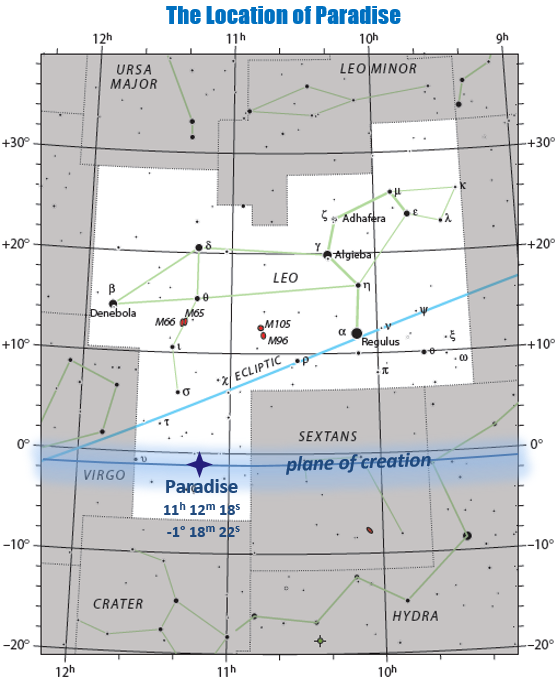
    Based upon the revealed number of “blazing suns” in Orvonton and the revealed distance to Uversa, we can conclude that Orvonton is almost certainly no smaller than the Local Group. Based upon the revealed internal structure of the grand universe, we can predict that the distance to Paradise should then be no less than 2.3 times the radius of the Local Group. If we test this prediction based upon revelation by assuming Orvonton is the Local Group, we make the thrilling discovery that the authors are correct. We can actually observe the ring-like cosmic structure of the superuniverse space level containing the other six superuniverses. We can locate the Isle of Paradise at the geometric center of the superuniverse space level. It is in the region of the Leo Constellation.

    George


  9. A postscript to the previous post:

    For those interested in the 7 previous studies on “What is Orvonton?” I mentioned, here are the links to them:

    Norm Du Val (1966) How Large is Orvonton, Really?
    Dan Massey (1979) Is the Milky Way Orvonton?
    Frederick L. Beckner (2002) Stars, Galaxies, Superuniverses, and the Urantia Book
    Sergey V. Chupin (2009) Cosmology of Uversa, Urantia and the Big Bang Myth
    Gary Tonge video (2010) Journey Through the Universe – Urantia Book
    Richard Bain video (2011) Modern Astronomy and the Urantia Book
    John Causland video (2014) Reconciling Urantia Book Cosmology with Modern Astronomy

  10. addendum to previous post

    Here are links to the previous studies mentioned:

    Norm Du Val (1966), How Large is Orvonton, Really?

    (Orvonton is the Milky Way and its satellite galaxies)

    http://urantia-book.org/archive/studyaid/orvonton.html

    Dan Massey (1979), Is the Milky Way Orvonton?

    (Orvonton contains 1,000 Milky Ways)

    http://urantia-book.org/archive/science/milkyway.htm

    Frederick L. Beckner (2002), Stars, Galaxies, Superuniverses, and the Urantia Book

    (Orvonton has a radius between 1 and 16 million light-years)

    http://www.squarecircles.com/articles/pdf/StarsGalaxiesSuperuniversesUB.pdf

    Sergey V. Chupin (2009), Cosmology of Uversa, Urantia and the Big Bang Myth

    (Orvonton is the Virgo Supercluster)

    http://www.sciteclibrary.ru/texsts/eng/stat/st3303eng.pdf

    John Causland video (2014), Reconciling Urantia Book Cosmology with Modern Astronomy

    (Orvonton is the Virgo Supercluster)

    http://www.ubastronomy.com/

  11. addendum:

    Here are links to previous studies mentioned:

    Norm Du Val (1966) How Large is Orvonton, Really?

    Dan Massey (1979) Is the Milky Way Orvonton?

    Frederick L. Beckner (2002) Stars, Galaxies, Superuniverses, and the Urantia Book

    Sergey V. Chupin (2009) Cosmology of Uversa, Urantia and the Big Bang Myth

  12. Addendum: list of previous studies

    Norm Du Val (1966) How Large is Orvonton, Really?

    Dan Massey (1979) Is the Milky Way Orvonton?

    Frederick L. Beckner (2002) Stars, Galaxies, Superuniverses, and the Urantia Book

    Sergey V. Chupin (2009) Cosmology of Uversa, Urantia and the Big Bang Myth


  13. ADDENDUM: Links to previous studies on “What is Orvonton?”


    Norm Du Val (1966), How Large is Orvonton, Really?

    http://www.urantia-book.org/archive/studyaid/orvonton.html

    Dan Massey (1979), Is the Milky Way Orvonton?

    http://www.urantia-book.org/archive/science/milkyway.htm

    Frederick L. Beckner (2002), Stars, Galaxies, Superuniverses, and the Urantia Book

    http://www.squarecircles.com/articles/pdf/StarsGalaxiesSuperuniversesUB.pdf

    Sergey V. Chupin (2009), Cosmology of Uversa, Urantia and the Big Bang Myth

    http://www.sciteclibrary.ru/texsts/eng/stat/st3303eng.pdf

    Gary Tonge video (2010), Journey Through the Universe – Urantia Book

    Richard Bain video (2011), Modern Astronomy and the Urantia Book

    John Causland video (2014), Reconciling Urantia Book Cosmology with Modern Astronomy

    http://www.ubastronomy.com/


  14. ADDENDUM: links to previous studies

    Norm Du Val (1966), How Large is Orvonton, Really?

    http://www.urantia-book.org/archive/studyaid/orvonton.html

    Dan Massey (1979), Is the Milky Way Orvonton?

    http://www.urantia-book.org/archive/science/milkyway.htm

    Frederick L. Beckner (2002), Stars, Galaxies, Superuniverses, and the Urantia Book 

    http://www.squarecircles.com/articles/pdf/StarsGalaxiesSuperuniversesUB.pdf

    Sergey V. Chupin (2009), Cosmology of Uversa, Urantia and the Big Bang Myth

    http://www.sciteclibrary.ru/texsts/eng/stat/st3303eng.pdf

    Gary Tonge video (2010), Journey Through the Universe – Urantia Book

    http://www.youtube.com/watch?v=9CkbbohKDoY

    Richard Bain video (2011), Modern Astronomy and the Urantia Book

    http://www.youtube.com/watch?v=GegBhg-ztNQ

    John Causland video (2014), Reconciling Urantia Book Cosmology with Modern Astronomy

    http://www.ubastronomy.com/

  15. ADDENDUM: links to previous studies on “What is Orvonton?”

    Norm Du Val (1966) How Large is Orvonton, Really?

    Dan Massey (1979) Is the Milky Way Orvonton?

    Frederick L. Beckner (2002) Stars, Galaxies, Superuniverses, and the Urantia Book

    Sergey V. Chupin (2009) Cosmology of Uversa, Urantia and the Big Bang Myth

    John Causland video (2014) Reconciling Urantia Book Cosmology with Modern Astronomy

    There are also two youtube videos:

    Gary Tonge video (2010), Journey Through the Universe – Urantia Book
    Richard Bain video (2011), Modern Astronomy and the Urantia Book

  16. ADDENDUM: other studies on “What is Orvonton?”

    Norm Du Val (1966) How Large is Orvonton, Really?

    Dan Massey (1979) Is the Milky Way Orvonton?

    Frederick L. Beckner (2002) Stars, Galaxies, Superuniverses, and the Urantia Book

    Sergey V. Chupin (2009) Cosmology of Uversa, Urantia and the Big Bang Myth

    Gary Tonge video (2010) Journey Through the Universe – Urantia Book

    Richard Bain video (2011) Modern Astronomy and the Urantia Book

    John Causland video (2014) Reconciling Urantia Book Cosmology with Modern Astronomy


  17. ADDENDUM: list of previous studies

    Norm Du Val (1966), How Large is Orvonton, Really?

    Dan Massey (1979), Is the Milky Way Orvonton?

    Frederick L. Beckner (2002), Stars, Galaxies, Superuniverses, and the Urantia Book

    Sergey V. Chupin (2009), Cosmology of Uversa, Urantia and the Big Bang Myth

    Gary Tonge video (2010), Journey Through the Universe – Urantia Book

    Richard Bain video (2011), Modern Astronomy and the Urantia Book

    John Causland video (2014), Reconciling Urantia Book Cosmology with Modern Astronomy

  18. Hi George, tas and Will,

    If (as I’ll be suggesting) nine of the ten major divisions of Orvonton will be “observable” only as an excess of neutrinos, then the following might be one of those “many statements that stand in need of revision”,

    “Of the ten major divisions of Orvonton, eight have been roughly identified by Urantian astronomers.” (167.20, 15:3.4)

    Was this just encouragement to make us look more closely?

    [Back to the story] As you know, I’m proposing that the superuniverse space level begins as an annular beltway of emergent energies in motion about Paradise. (This apparent orbital motion is not driven by gravity; it’s simply a general motion through space along “a space path of lessened resistance to motion”.) And that the seven superuniverses evolved within this homogenous distribution of emergent energies, under the direction of Architects, via the influence of force organizers.  In other words, literally what the authors wrote.

    Ok, now for some astronomy.

    Recall McCall’s “Council of Giants”. For reference, the first picture below shows what McCall discovered in the accumulating astronomical data ( Giants story here, original preprint here )

    http://www.ubron.org/groupphotos/YouAreHere_1.jpg

    The next diagram below zooms to a region of interest:

    http://www.ubron.org/groupphotos/YouAreHere_2.jpg

    This third diagram (below) indicates more clearly the raw data:

    http://www.ubron.org/groupphotos/YouAreHere_3.jpg

    And finally, below is an “artist’s impression” of how the grand universe falls into place:

    http://www.ubron.org/groupphotos/YouAreHere_4.jpg

    Notice how simple that was.

    But (“Ground Control to Major Tom”) surely not. This is too “neat and tidy” to be real.

    Maybe. A question any reasonable reader must ask:

    “If things were really like this, why can’t astronomers see those “trillions of blazing suns” in neighbouring sectors and superuniverses?”

    In this regard, a reader at UBRON wrote:

    “You also mention laying Andromeda on edge. Would you care to revise your question? Have you missed the images showing a number of galaxies edge on? If you ask me, they are far from hidden.”

    Recall that (angle subtended) = (size of object)/(distance to object),  or theta = R/D. Next post will clarify.

    Up next, some more astronomy (hard numbers!) to explain the difficulties astronomers face.

    Nigel

  19. PS: before moving on, another reader asked:

    “In the last diagram, what is the ring that M31 belongs to called? The quiet zone or the first outer space level?”

    How about we call that region “the present ragged edge of the grand universe”. (Sorry for not making it more ragged)

    (129.11, 12:1.13) “The present ragged edge of the grand universe, its uneven and unfinished periphery, together with the tremendously unsettled condition of the whole astronomical plot, …”

    For reference, here’s that updated diagram I’ve been referring to:

    (170.1, 15:4.7) “though Andromeda, which is outside the inhabited superuniverse, …”

    Nigel

  20. Hi Nigel,

    It seems like quite a stretch to suppose that the statement of historic fact, “eight [major sectors] have been roughly identified by Urantian astronomers,” is one which can be “revised” to mean “no major sectors have been observed and identified by Urantian astronomers.” The full sentence in which the word “revision” is used explicitly asserts that the historic facts in this revelation will not need to be revised at any time in the future.

    “We full well know that, while the historic facts and religious truths of this series of revelatory presentations will stand on the records of the ages to come, within a few short years many of our statements regarding the physical sciences will stand in need of revision in consequence of additional scientific developments and new discoveries.” (101:4.2)

    George

Reply on the current forum

↑ Back to top