The Missing Manger: The Urantia Book and the Standard Reference Text Committee
June 1, 2026
In a recent study group we were reading Paper 119, “The Bestowals of Christ Michael,” and one of our participants read this paragraph out loud:
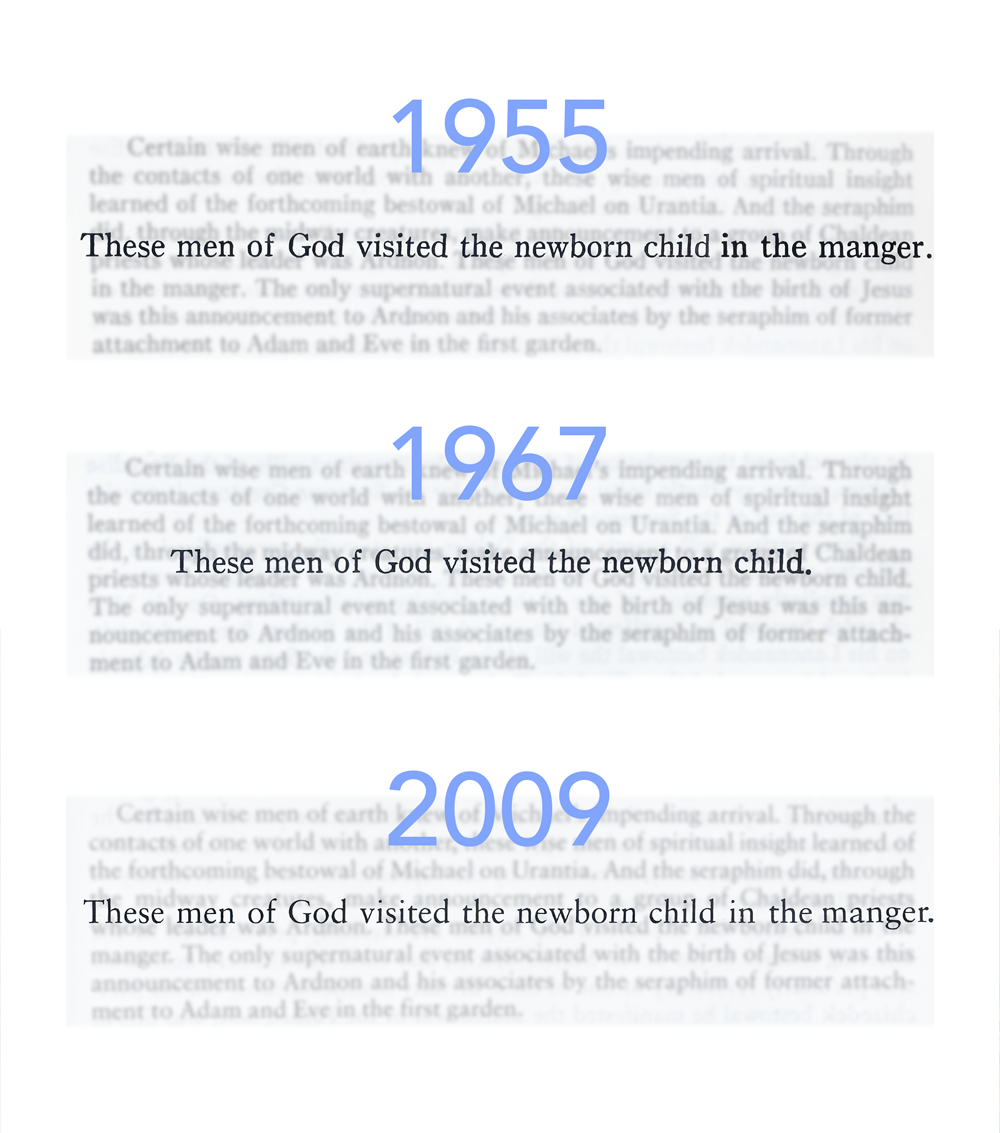
Certain wise men of earth knew of Michael’s impending arrival. Through the contacts of one world with another, these wise men of spiritual insight learned of the forthcoming bestowal of Michael on Urantia. And the seraphim did, through the midway creatures, make announcement to a group of Chaldean priests whose leader was Ardnon. These men of God visited the newborn child. Paper 119:7.6 (page 1317.2)
I asked the reader to re-read that last sentence. She read it again, “These men of God visited the newborn child.” Period.
The edition I was reading was a current Word docx downloaded from Urantia Foundation’s website, which read “These men of God visited the newborn child in the manger.” [emphasis added]
Years ago, I heard this “in the manger” phrasing was in the first printing and removed in the second printing. I checked my copy of the first printing and there it was: “These men of God visited the newborn child in the manger.”
Apparently, the manger got returned sometime after the second printing.
This “in the manger” statement in the first printing is something of a controversy, as we read in Paper 122 “Birth and Infancy of Jesus” that Mary and Joseph only spent a couple of nights in the makeshift stable space and spent the next three weeks in a room provided by an acquaintance’s friend. (122:8.3) It appears to be a contradiction, an oversight, or perhaps a figure of speech, as a manger is basically a feed trough the infant Jesus was placed in at birth, so Jesus would not have been “in the manger” when the group of Chaldean priests made their visitation. (I have heard one reader comment that perhaps the feed trough got moved to the inn, but that’s a separate conjecture not necessarily relevant to this task at hand).
A History of Corrections
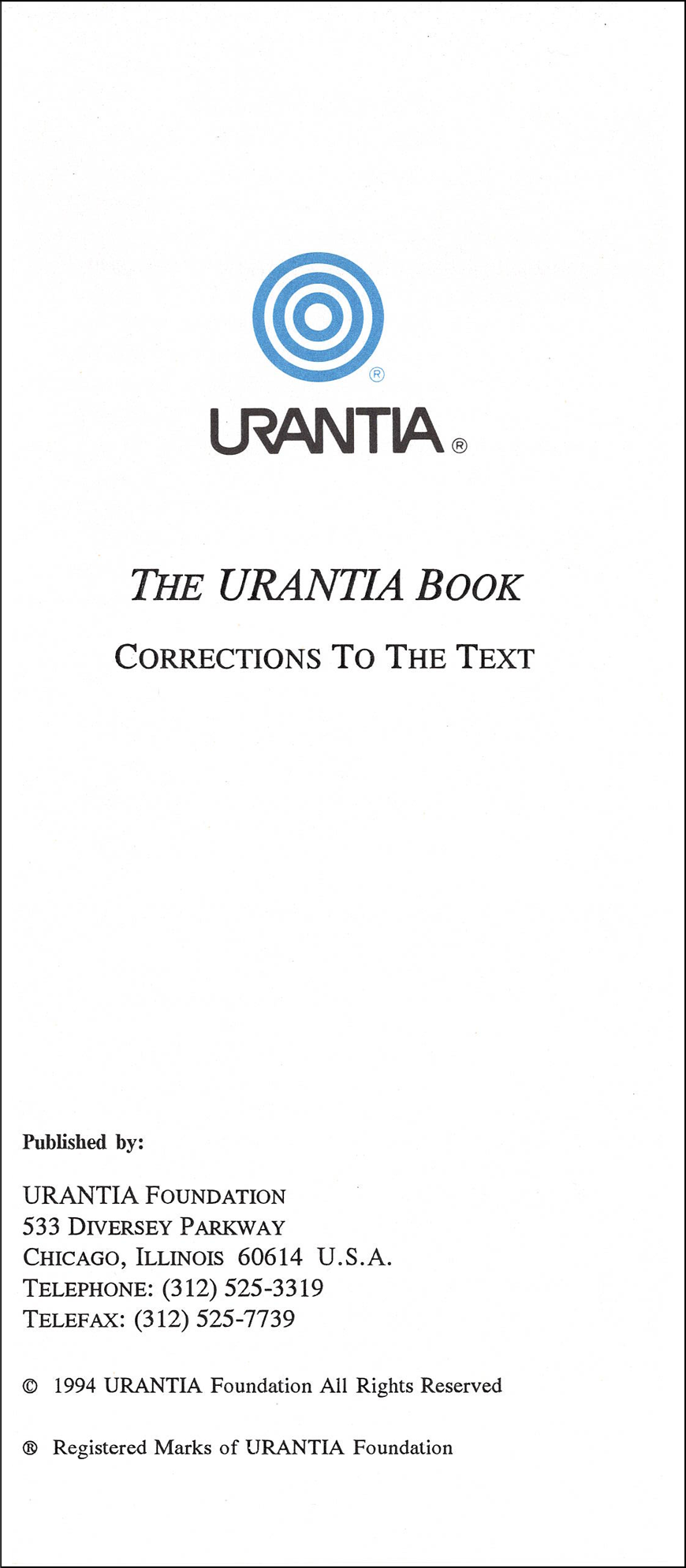
After the initial publication of The Urantia Book in 1955, multiple errors were detected and corrected with the 1967 second printing. The majority of these errors were typographical. A publication “Corrections to the Text,” published in 1994, cites 55 corrections appearing in the 2nd printing, the greatest number of corrections of all the subsequent printings:
Corrections pamphlet distributed by Urantia Foundation, 1994
12 in the 3rd printing (1971)
12 in the 4th (1973)
1 in the 5th (1976
6 in the 6th (1978)
11 in the 7th (1981)
none in the 8th (1984)
2 in the 9th (1986)
32 in the 10th (1990)
10 in the 11th (1993)
This indicates a total of 141 corrections, but it’s helpful to note that according to SRT Committee member Ken Keyser:
The challenge with reporting these numbers is the fact that several of the corrections over the years were actually a reversal of previous corrections made in an earlier printing. Also, these numbers include items that were corrected in the Table of Contents, which were not corrections to the text of the book. The actual total number of unique items in the text of the book that were handled during the first eleven printings was around 80 items.
Over the years some readers have raised concerns about corrections made after the first 1955 printing. With a text nearly 2100 pages in length composed with over one million words (The Urantia Book Concordance published in 1993 states there are 1,120,913 words), the chance of errors is likely. But with a text that was carefully edited and proofed over two decades before publication, and claiming celestial authorship, the idea that the printed version not only contains errors, but that humans have corrected those errors, has been unsettling to some readers.
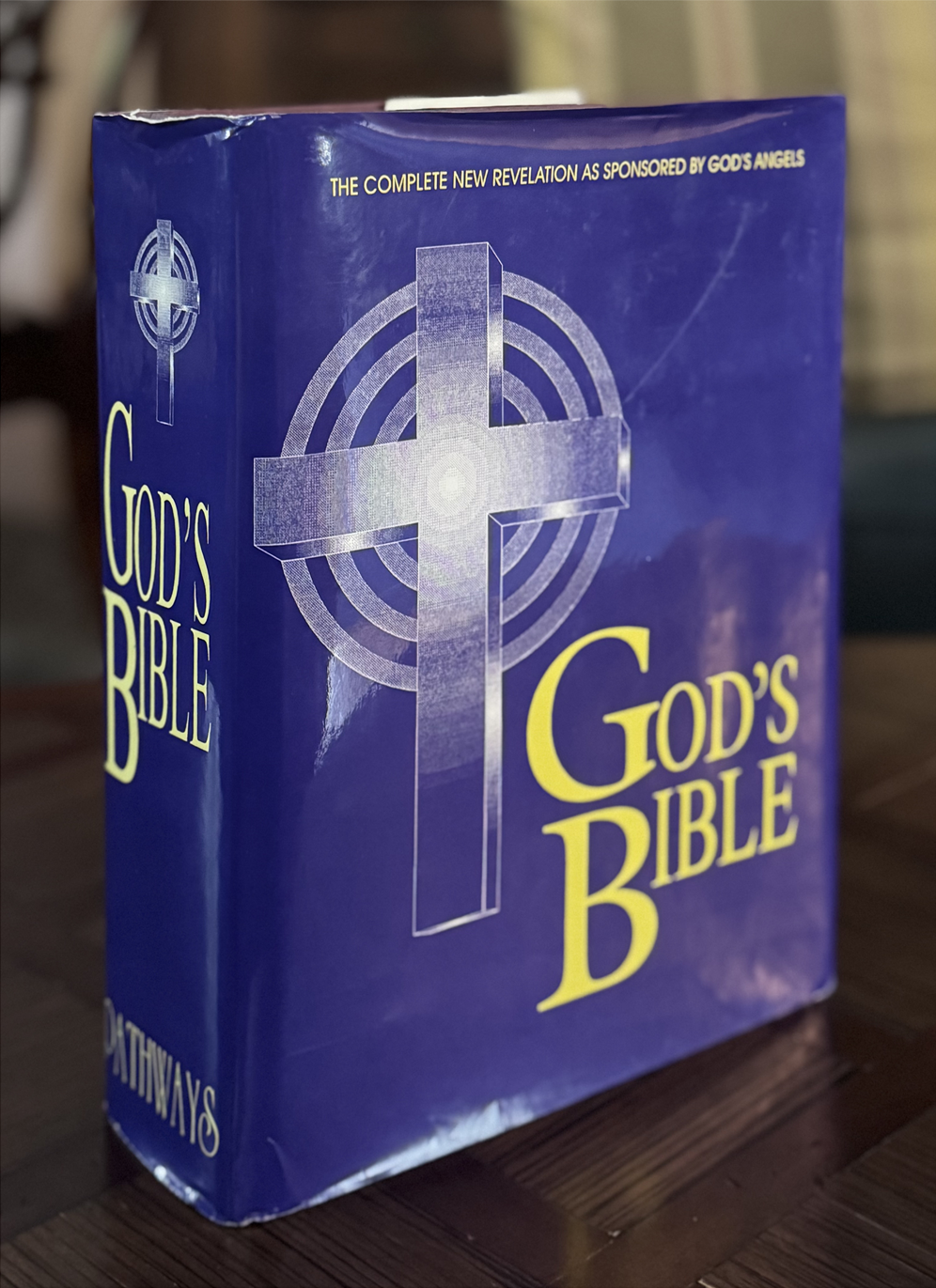
God’s Bible published by Pathways, Inc. was a reprint of the original 1955 printing.
Two attempts by individual readers to assuage these concerns occurred in 1995 with the publication of God’s Bible and The Urantia Papers by Pathways, Inc. These were both reprints of the first printing with different titles to appeal to different populations. Another reprinting of the 1955 printing occurred in 2017. This was a full replica of the first printing complete with a light blue dust jacket reminiscent of the first printing’s cover, but with the statement “The 1955 Inviolate Text” underneath the title.
Another conflict in assurances of providing a “text inviolate” was the 1996 publication of The Urantia Book by Uversa Press. Printed under the auspices of The Fifth Epochal Fellowship (now The Urantia Book Fellowship), this edition was a complete transcription of the most current printing, and diverged from Foundation printings by featuring a double-column format, an index (in later editions), and because of the alternative formatting of the text, different pagination from the Foundation’s single column format. To avoid reference confusion when using both texts in study groups and other circumstances, the page numbering of the 1955 edition was inserted in the Uversa printings wherever those page breaks occurred and the Paper:Section.Paragraph referencing system was introduced, which is still in use today for referencing quotes from The Urantia Book (it is the UAI Journal’s editorial policy to include the Foundation text page number in parentheses for block quotes, as in the quote at the beginning of this article).
Uversa Press 1996 edition of The Urantia Book.
The Uversa Press version went on the market soon after the case Urantia Foundation vs. Maaherra was settled in United States District Court, D. Arizona1 on February 10, 1995, which ruled that the Foundation’s copyright renewal of the text was invalid. Urantia Foundation appealed this decision, and on June 10, 1997 the United States Court of Appeals, Ninth District ruled that Urantia Foundation’s renewal copyright was valid, reversing the lower court’s decision. Any appeal at this point would need to go before the US Supreme Court, and no further appeal was made by Maaherra. Uversa Press withheld its publication of The Urantia Book for the next few years.
However, another suit was soon filed to contest Urantia Foundation’s copyright renewal. According to Urantia Foundation Online Newsletter from June, 2000:
On May 12, 2000, Michael Foundation, Inc., owned by Harry McMullan, III, filed suit against URANTIA Foundation in the United States District Court for the Western District of Oklahoma challenging the validity of URANTIA Foundation’s copyright in The URANTIA Book. The lawsuit alleges that the Foundation’s copyright is invalid, or in the alternative, that Michael Foundation’s book, Jesus-A New Revelation, does not infringe the copyright. Michael Foundation is seeking to have the case heard in Oklahoma City, where Mr. McMullan resides.2
Harry McMullen III earnestly pursued this case against Urantia Foundation3, and two federal courts both ruled that Urantia Foundation was not entitled to a copyright renewal. In August, 2003, Urantia Foundation’s appeal to the US Supreme Court was denied.
The English Urantia Book text was now in the public domain.
As one can see from this statement in the Foundation’s 2003 annual report, the trustees struggled with this conclusion:
The year was not without its disappointments. In August 2003, the U.S. Supreme Court denied Urantia Foundation’s request to review the appellate court’s decision in Michael Foundation, Inc. v. Urantia Foundation. We are still assessing the implications of this decision for other publishers and developing strategies to preserve the inviolate text in the future. Urantia Foundation holds international copyrights in the English text as well as copyrights in its many translations, audio recordings, and computer software. Readers can identify the authentic products and services of Urantia Foundation by the concentric-circles symbol.4
The Fellowship straightaway began publishing the Uversa Press edition after Urantia Foundation ended its contest to retain the copyright.
Determining a Standard Reference Text
Once it was clear that the Fellowship would continue publishing the now public domain English text, in 2007 an ad hoc committee was established and chaired by then Urantia Foundation president Seppo Kanerva. This group was initially called the Committee on the Inviolate Text. Along with Seppo, two other Foundation representatives Jay Peregrine and Marilynn Kulieke sat on the committee. In a notable act of cooperation, Kanerva requested three members to represent the Fellowship’s Uversa Press edition, and Marvin Gawryn, Merritt Horn, and Nancy Johnson were appointed.
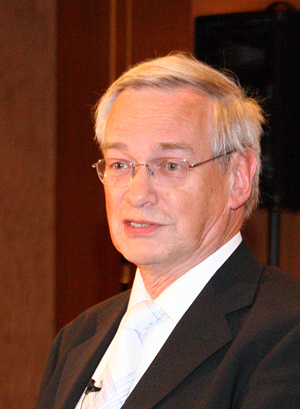
Seppo Kanerva
The May 2007 edition of Urantia Foundation News Online states:
The Committee is charged to examine all changes effected in the first printing text and determine whether or not the changes were and continue to be correct. Additionally, the Committee was asked to recommend an appropriate method for indicating the acceptable changes made in all published versions of The Urantia Book. At the completion of their work the Committee is to recommend the text that will be defined as the Inviolate English text.5
“Inviolate” is a strong word, and for some committee members it was possible there might not ever be an “inviolate” English text. In her bio on the Foundation’s SRT webpage Marilynn Kulieke offered this caveat:
Marilynn served on this committee because of her belief that we must no longer argue about the “inviolate text.” She feels that readers need to know the changes that have been made in the different editions of The Urantia Book over time so that they can evaluate these changes (e.g., text, formatting, and referencing system) without the feeling that there is a hidden agenda or intentional confusion.6
By September, 2007 the committee had been renamed the Standard Reference Text (SRT) Committee, and over the next two years the group reviewed and reconsidered all corrections introduced up to the most recent printing. In addition, they reviewed other suggested corrections provided by both readers and committee members. Each of these items were documented with copious notes regarding the committee’s decisions to reject or retain both older corrections and current requests. Corrections accepted unanimously by the committee were formally reported to Urantia Foundation Trustees for final approval in 2009.7
This substantial first report, with its thorough review of all corrections made from 1967 to 2009, as well as some new corrections, was adopted by both Urantia Foundation and the Urantia Book Fellowship and established the Standard Reference Text.
After the adoption of the Standard Reference Text, the SRT Committee continued meeting to consider corrections offered by readers, as well as items discovered by the committee in the course of their work. Suggestions were gathered and every three years (except 2012) the committee met to consider, debate, and approve or dismiss any requests.
The next SRT report is forecast for early in 2027. Prior to that, the Committee will meet multiple times to discuss various potential corrections before presenting its formal SRT 2027 report at a Urantia Foundation Trustee’s quarterly meeting.
So, what happened with “in the manger”? According to Ken Keyser, a current SRT Committee member:
Jay Peregrine, when speaking of how the SRT Committee’s work would be viewed by the readership, said “It will all come down to ‘in the manger.’ ” That phrase, with no known documented explanation, was removed in the second printing and is one of the strongest examples of a modification that required the Committee to adhere to its mission to retain the 1955 text as intact as possible. The corrections made to the early printings had a number of Contact Commissioners approving them. By the seventh printing there was just Emma “Christy” Christensen, the last living Contact Commissioner, approving them. The corrections were kept on a list, but again, with little or no correlated explanations.
Peregrine further offers this insight about Christy and her work with corrections:
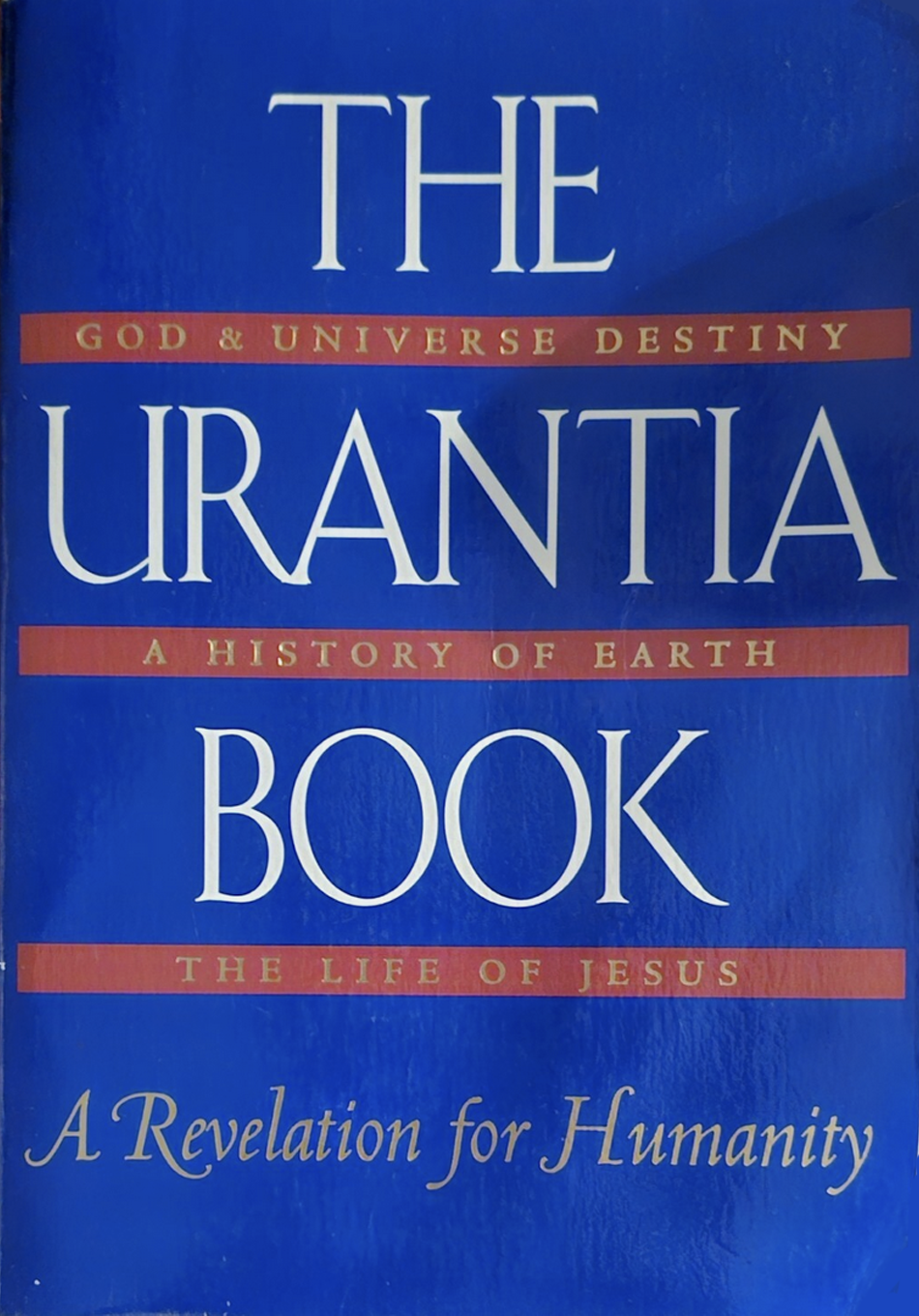
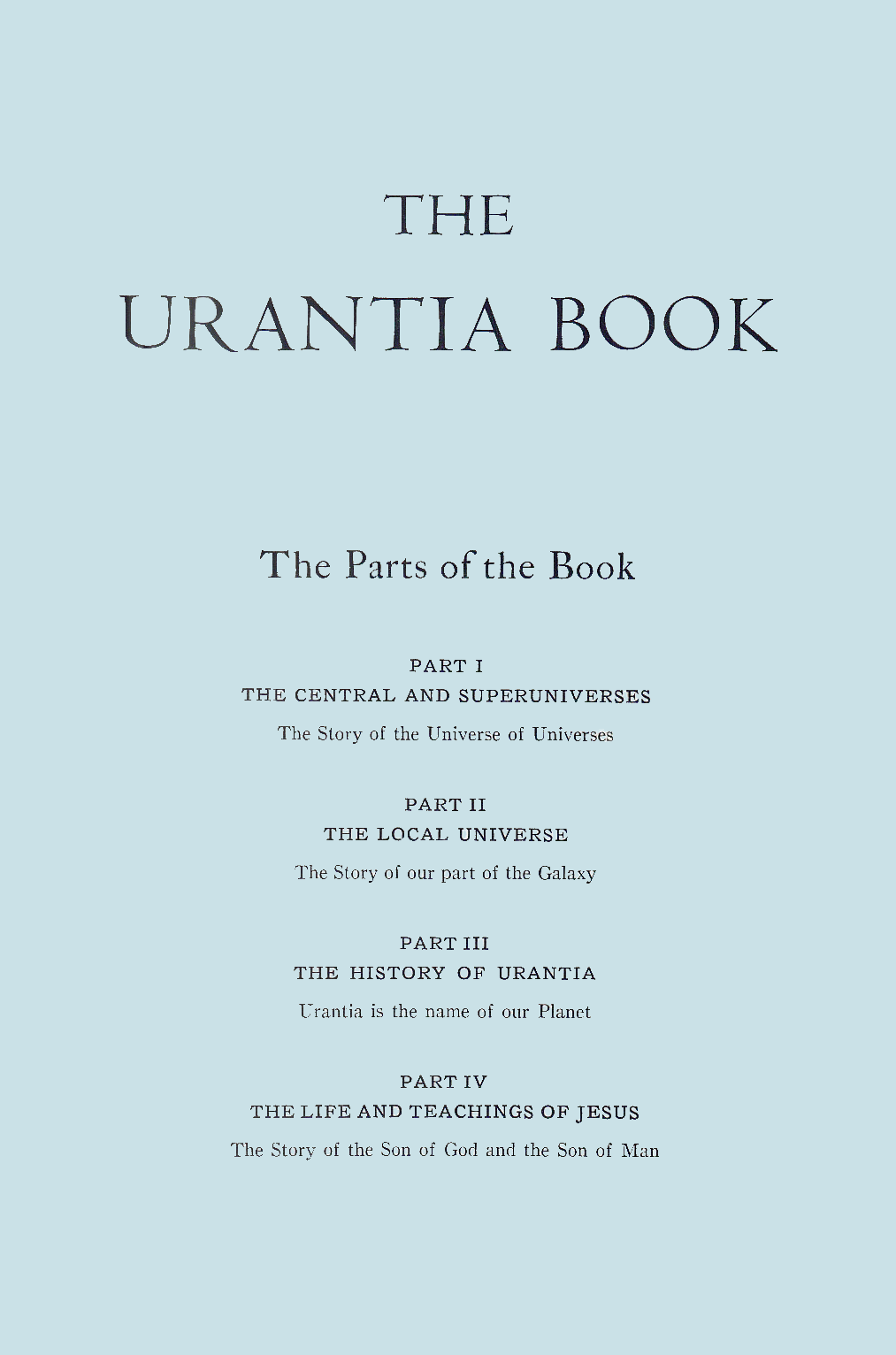
Dust cover of first printing of The Urantia Book, 1955
Christy maintained that all of the earlier corrections of what she called “the gremlins” were presented to the “unseen friends” for review and approval. She died in 1982, and the 8th printing was the last that she corrected. To some older readers it was this 8th printing which was the last to be “approved.”
In essence, as the SRT Committee reviewed all the corrections dating back to the 1967 second printing, unless there was a valid, strong, and documentable reason to keep a correction that departed from the original 1955 text, the original 1955 text held.
These corrections first appeared with editions published by Urantia Foundation and Uversa Press after 2009.
One item that did depart from the 1955 edition, and to which some readers may object, was the change in Paper 42, section 6 paragraph 7 (42:6.7) regarding the sizes of electrons and protons. By looking at the description of the size of a proton in the next paragraph (42:6.8) the SRT Committee made the decision to rephrase the first paragraph to be consistent with the second, offering this explanation:
The revised wording is consistent with the paragraph following the subject paragraph (42:6.8), where the author states that a proton is eighteen hundred times as heavy as an electron, and is also in general agreement with current scientific opinion which places the ratio at about 1:1836. The calculation of the relative masses of the electron and the hydrogen atom was undergoing a rapid evolution just prior to the writing of The Urantia Book, the ratio was estimated at 1:1700 in 1897, 1:2000 in 1904, and 1:1845 by 1922. This item and the related following item are the only changes recommended by the SRT committee that do not have a straightforward typographical explanation.8
SRT Committee member Merritt Horne offered this additional explanation of how the committee struggled with this correction:
The 1955 text was clearly wrong—it was both internally inconsistent with the following paragraph and scientifically incorrect—so we once again understood why the changes had been made in the second printing, but we could not figure out how any originally correct wording in the manuscript could have devolved into the erroneous and inconsistent wording that appeared in 1955. If we had followed our usual logic, we would have returned this to its original (1955) state, but the original was so glaringly wrong –internally and externally—and the fix had been done so long ago, we decided to leave it as it has been since 1967 in the hope that one day a more brilliant committee member than any of the present company might come up with a more acceptable explanation and resolution. This was not a satisfactory conclusion, but we decided that the best we could do was assume that the revelators would not be intentionally inconsistent, make the change, explain our decision, and move on.
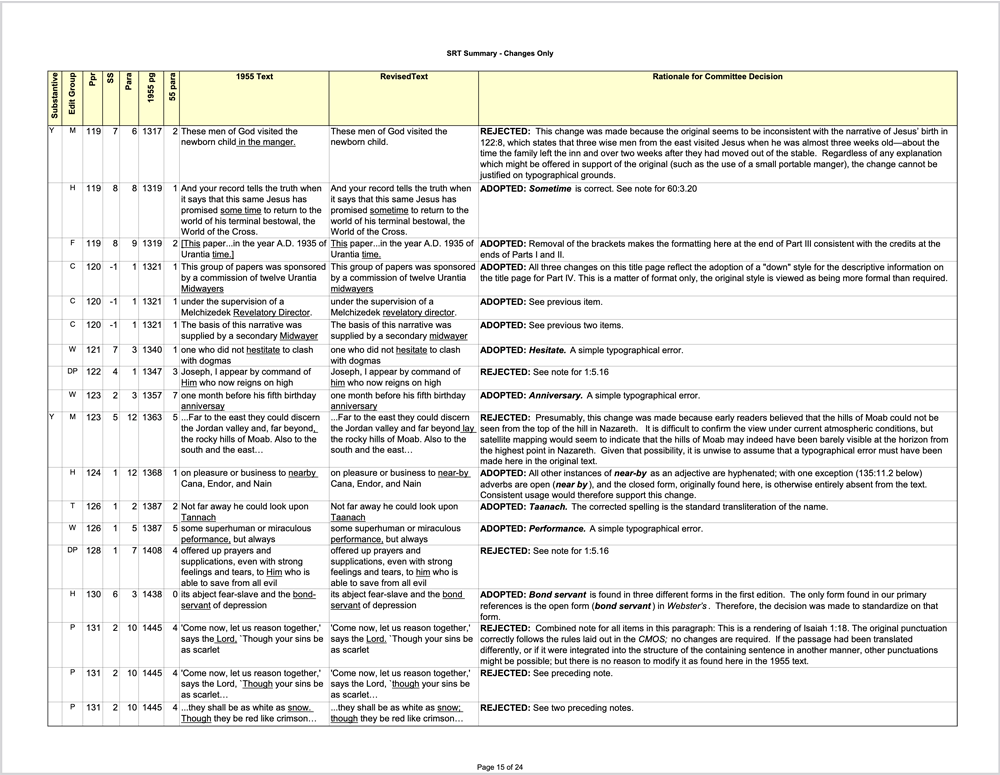
Sample of worksheet illustrating the SRT Committee’s published. notes on adopted and rejected corrections to the text.
Whether one agrees with this correction or not, the SRT transparently publishes its reasoning behind corrections for future readers and scholars to review.
All Urantia Book editions published by Urantia Foundation and Uversa Press since 2009 state in some manner on the publication information page that the edition is the Standard Reference Text. This is displayed in the 2017 Foundation edition:
The Standard Reference Text of The Urantia Book was developed by a group of scholars to protect the integrity of the original book. This text represents their best efforts to reconcile and correct the small number of typographical errors found in early editions of the book.
Urantia Foundation’s online version carries a shortened disclaimer with a link to the SRT information page. These SRT notices are critical for discerning the integrity of an edition. In our highly volatile world of digital publishing this ensures dedicated readers of The Urantia Book that the version they are studying has not been compromised.
It is a future task of the SRT Committee to designate when any corrections were made. This was a helpful feature of the 1994 “Corrections to the Text” pamphlet, and documenting when corrections appear in each version will clarify any irregularities readers may discover between different printings and editions.
It is worth stating here that overall, the number of corrections to The Urantia Book have been few and minor. Any English edition one uses in a study group is sufficient to the task of reading aloud and sharing thoughts. For scholarly work and quoting it is ideal to use the most current edition, but in a study group setting any of the previously printed editions are solid, and virtually all corrections have to do with spelling, punctuation, and grammar.
The Future
I recently discovered a “revised” Urantia Book on Amazon that changed “obsolete and outdated concepts and ideas” particularly in areas of race and cosmology, and sells this version divided in three separate volumes. Another version of the book released a few years ago uses gender-neutral language, and removes some of the racial content and other items deemed objectionable. These are two examples of deliberately changing the text, and to their credit, the publishers were up front about the revisions they undertook.
But what prevents anyone from making a few small, less detectable changes––and publishing that altered version without a disclaimer?
This is where Urantia Foundation has a critical role in the future.
Urantia Foundation-published Urantia Books and downloads from urantia.org assure the reader that these versions of The Urantia Book are indeed the “inviolate” text, and any corrections from the 1955 first printing are transparently noted on the Foundation and Fellowship’s websites.
One of the results of the lawsuits of the 1990’s and early 2000’s was a re-assessment of the 1950 Declaration of Trust which established the groundwork for Urantia Foundation. Although Urantia Foundation no longer holds the copyright nor can legally contest other versions of the English text, its task is now to be guardian of the “inviolate” text. Urantia Foundation trustees are the guarantors that a reader is in possession of the most authentic version of the original text––with any corrections and the reasoning behind those corrections readily and transparently available. In fact, this assurance is the first duty of trustees in the Declaration of Trust:
3.1. PRESERVATION OF TEXT OF The Urantia Book: It shall be the primary duty of the Trustees to perpetually preserve inviolate the text of The Urantia Book, and the Trustees shall use and employ such means, methods, and facilities and apply and expend as much of the Trust Estate as in the judgment of the Trustees shall be necessary, proper, or appropriate, for the preserving and the safekeeping of copies of the original text of The Urantia Book, duly authenticated by the Trustees, from loss, damage, or destruction and from alteration, modification, revision, or change in any manner or in any particular.9
This primary duty is still Urantia Foundation’s most important task going forward. And the Standard Reference Text Committee is a crucial gatekeeper in that task.