


Leadership Roundtable at Urantia Foundation
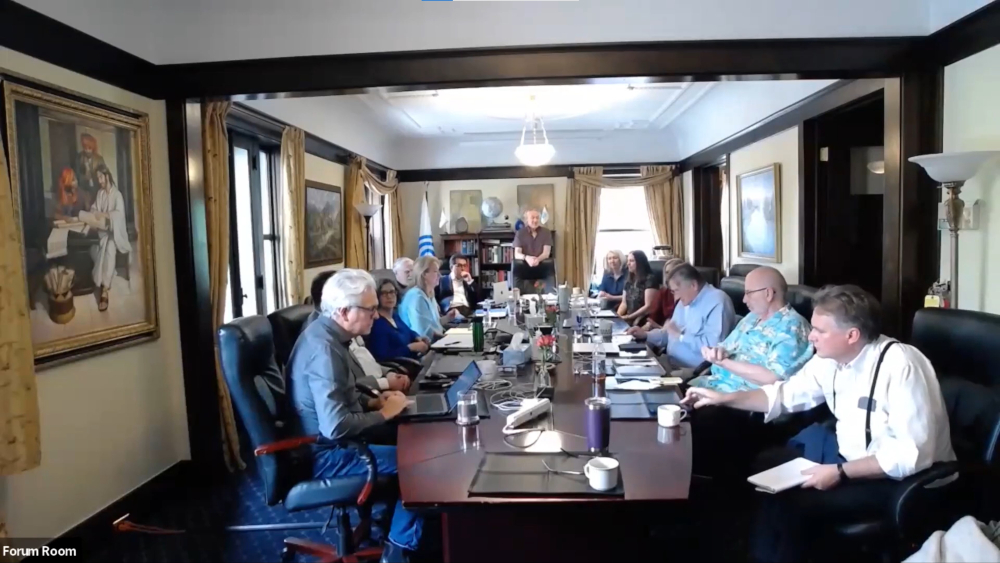
Do you sometimes wonder what’s happening out there in Urantia World? How awareness of The Urantia Book is getting out there? Are you curious about what disseminators are doing? Over the weekend of April 25th, an unprecedented gathering took place at Urantia Foundation. Organizations, creators, educators, and leaders gathered to share what they’re doing, their aspirations and visons for a more beautiful union of souls, working together in greater cooperation to share the revelation with the world. Following is a synopsis of the presentations.
The first presentation was given by Tamara Strumfeld, Executive Director of Urantia Foundation. Tamara outlined the evolution of the Foundation’s translation work, from the first French translation to its current list of twenty-six languages. Everyone was happy to learn that for each language, websites are created to platform The Urantia Book and allow for reading the book online and downloading it for free. To date there are 947,029 downloads of the book, and here’s a fascinating statistic: Bulgarian and Romanian translations lead the number of downloads, followed by Farsi. Tamara noted that translations undergo ongoing revisions which can take a decade of refinement, and the translation team works to continually improve their processes. The Foundation intends to translate The Urantia Book into 90 languages.
Next, Line St-Pierre, President of Urantia Association International, talked about its mission to disseminate the teachings and foster study of The Urantia Book. This mission is materialized through its 30 constituent associations around the world, whose efforts largely focus on supporting local study group formation, book fair participation and regional conferences. Line highlighted the Association’s support of local leaders in Senegal working to educate young people about The Urantia Book.
Myra Hight, Communications Chair, shared progress on the Association’s Long-Range Plan which includes creating a mentor program for new students of the book, supporting readers in countries without formal Associations, and the creation of a new study group educational program. Her five-minute video can be viewed here.
Sue Seccombe, President of The Urantia Book Fellowship, shared their vision and mission. The vision: A global community promoting spiritual transformation by sharing a revelation of living truth. The Mission: To uplift and serve humankind by effectively sharing the Urantia revelation and to foster an exemplary community where all who search can spiritually thrive. Sue discussed how effective sharing has taken center stage in their efforts. Their focus is on connecting with those who seek, instead of using the ineffective proverbial firehose approach.
Geoff Theiss, Executive Director of The Urantia Book Fellowship, presented statistics they have collected, showing growth patterns and trends that can and should guide the direction of efforts going forward. His talk mapped non-linear regional connections and trends, and concluded with the importance of leaders connecting with local readers.
Maya Anazodo of Nigeria, is a young, second-generation reader. Her notable contribution to the discussion emphasized that approaching young people is best done when their contemporary language is used to engage them where they are. For instance, using words like self-development, spiritual growth, manifestation, vibration, alignment, etc. Maya suggested a step-by-step strategy: doing small outreach to a handful of youths at a time, bringing them together in Zoom gatherings for presentations on concepts that incorporate their common language, followed by gently expanding the meanings of those familiar words to the teachings. For instance, discussing alignment and tying this to alignment with the Thought Adjuster, or tying manifestation to personally manifesting those things which are essential to spiritual growth. In essence, elevating their relatable common language to incorporate teachings from The Urantia Book.
Podcaster Derek Grimm spoke about recognizing that the fragmentation of the three main organizations is inhibiting the potential for growth. His message was one of coordinating efforts to make better use of limited funding. He also addressed the risk of westernizing valuable secondary works such as videos and books. Derek suggests that translations of important videos and other secondary works is crucial, that the revelation must be relatable for the many cultures around the world if the revelation is to be attractive to all peoples. He left us with the question: Are we willing to think and act at the scale the revelation deserves?
Gaetan Charland presented his project, Sowers of Seeds of Truth, whose mission is to sow, not convince. Gaetan has developed a turn-key kit of materials consisting of a guide, a collection of fact sheets on various topics in the book, and a quick reference card of key concepts to use in discussions when introducing the book to others. The kit contains secondary books translated into French, printed seeding tools such as brochures and spiritual cards, materials that can be left in places like waiting rooms and casual gathering spaces. Stickers and cards are also in the kit, like bumper stickers, and a strategy sheet for utilizing different venues from social media to libraries.
Emeka Anazodo, father of Maya Anazodo, shared on his work in Nigeria. Emeka experienced the familiar story of wanting to shout to the world about The Urantia Book, but then he found a way to meet truth seekers where they are. Emeka discussed how he uses the word “manifestation” to engage, expand, and reveal the teachings gradually, in a manner than can be digested at the pace of the individual. Once doors of acceptance are opened more can be revealed. Emeka has been successful using this technique to share The Urantia Book with many people throughout Nigeria. Emeka expressed the need for secondary works to meet the commonalities within the world’s many cultures.
This concluded the first day’s presentations. Day two focused on education.

Alejandra Rodriguez shared her success in sharing her project of growing leaders in Latin America and Dubai, the methods they use to develop leadership skills. They educate leaders on the use of vocabulary to meet communities where they are.
Discussing the importance of expanding study groups, Joyce Anderson presented an overview of the Study Group Directory’s work. The directory has 550 registered study groups. To meet the challenge of establishing 1000 groups in the first 100 years of the revelation, their goal is to add 30 groups per year over the next thirty years. The importance of study groups cannot be overstated; they are a place for social gathering and deep study. Joyce emphasized the importance of quality in study groups and the ingredients necessary to create quality groups.
Rick Warren discussed his study group tour which was presented in Tidings, December 2025. One idea he encountered for creating a dynamic study group is to invite guest speakers.
Gaetan Charland continued the discussion on study groups with his presentation titled Weaving Revelation. Gaetan pointed out that training leaders and facilitators is crucial for their success. He posed a question to readers who have pursued education through formal schools, such as Urantia Book International School (UBIS) and Urantia University Institute (UUI), “Are you using your education to host a study group?” Gaetan participated in the development of the Association’s new Study Group Educational portal. To learn more about this portal please contact Wilson Leon, The Association’s Study Group Chair.
Guidelines for effective facilitation will soon be available on the Study Group Directory, and through the educational program soon to be offered by Urantia Association.
Marvin Garwyn gave a presentation on Spiritual Living Support Groups. Marvin’s project began by exploring the viability of spiritual living support groups, small gatherings of readers meeting regularly to support, encourage, and inspire each other on ways to grow their loving relationships with God and their fellow men and women. These groups are not therapy, they are designed to help participants develop own spiritual practice, to be exposed to other perspectives, and discover practical ways to learn from within. The goal is for several groups to form and be governed autonomously. This project will soon be available on the UUI platform.
Joyce Anderson presented structured Jesus Celebrations organized by study groups, to celebrate Jesus with topical discussions covering sections from Part IV of the book.
Elizabeth Callahan, Executive Director of Urantia University Institute, introduced leaders from several educational organizations including UBIS, UUI, and UAI. Jay Han opened this segment with a short video exemplifying the important message of cooperation, which was echoed within many presentation messages.
Pre McGee, Education Chair, presented the Association’s new global educational platform intended to train leaders and empower teachers. Education is transformation, and education in a digital world must adapt to meet people where they are. The purpose of this new platform is to offer educational resources and experiential opportunities to stimulate study, growth, and spiritual development across all our Constituent Associations.
Pre also shared recent research on religious trends around the world. Africa is becoming the new spiritual centre, Asia remains the most religiously diverse region, and Europe and Oceania continue to secularize. She talked about the history of Urantiathons, which you can watch here (3 min). Pre also shared a glimpse into Brazil’s online school, Escola Urantia, which has provided over 750 active students more than 200 courses since its inception.
Joanne Strobel, Executive Director of Urantia Book International School, offered an overview of the long-running program which offers courses in nine languages, three times a year. Joanne shared the mission and philosophy of UBIS which embraces a peer-to peer approach, without hierarchy or interpretation. Students become facilitators, and facilitators often become staff members. Over the years, UBIS has served as a vehicle for training future leaders, many of whom go on to serve in reader organizations, participate in cultural and scientific symposiums, present at webinars and Urantiathons, or even become advisors, or area coordinators. The UBIS model intentionally moves away from passive learning. It requires students to actively engage with the text and uncover revealed truths for themselves, rather than have it handed to them. While its pedagogy runs counter to contemporary educational shortcuts, it is central to our mission.
Elisabeth Callahan introduced Urantia University Institute and the school’s philosophy of providing education to anyone who seeks to learn, to develop the whole person through study, worship and service. Their educational mission is to provide in-depth, rigorous study of the entire Urantia Book, from beginner to advanced levels. UUI offers several programs including its Teacher Education Program (TEP), which is a year-long in-depth study of the entire Urantia Book. They offer instructor-led courses on Zoom, asynchronous self-directed courses offered in English, Spanish, French and Korean, UUI Cafes, Sunday Worship sessions, Homecoming Gatherings, and its new Bower Tree Early Childhood Education Project, all of which are intend to build an interactive spiritual community.
Gabriel Rymberg, The Center For Unity President, presented an update on activities at the Center for Unity to their AI-assisted translation of secondary works and multimedia projects — including Joshua’s Workshop, Spiritual Translations, and the Angelic Story of Jesus.
David Kantor presented an overview of multimedia and Urantia Book content which you can watch here.
Jum Zigarelli, Truthbook Webmaster, described their efforts to reach audiences in a fast-changing internet landscape.
Urantia Foundation’s Digital Programs Manager, Brad Gardner, discussed the ingredients and importance for Urantia groups to create websites that are beautiful, reverent, and saving, more akin to a sanctuary than a marketplace.
Ari Horn, Geoff Theiss, and Marvin Garwyn each shared a success story of how service has made an impact.
Jeannie Vazquez, Urantiathon Chair, spoke about the importance of social media as a tool to reach truth seekers. Her presentation is so important we’ve given it its own space in this issue.
Rick Lyon shared his and Susan’s Cosmic Creations website, where readers can find Urantia related items including art, books, clothing and jewelry. Started in 2014, cosmiccreations.biz is a non-profit business whose purpose is to make secondary works and creative expressions available to readers. There’s nothing like wearing the circles and having someone come up to you saying, “I read The Urantia Book!”
Gary Tonge presented Channel 606, a website to platform curated, high quality topical video productions, podcasts, music, and docuseries. Gary discussed the challenges of producing quality material—the production cost, the limited resources available, and the disadvantages of distribution on YouTube with its over-saturation and the common theft of copyright content. Gary presented his solution, a channel for Urantia related content. He proposes the best way forward is for creators to merge into a collective, to increase their scope, and attract funding to benefit everyone. Derek Grimm, a contributor to Channel 606 and founder of Urantia TL;DR, discussed AI and video production using Unreal Engine, a tool to create AI productions, and the advantages and opportunities Unreal Engine provides. Channel 606 is a vison that is coming to life, beautifully.
The roundtable inspired collaboration and connection. It showed us all the importance and value of working together, supporting each other, and sharing ideas and opportunities, rather than existing in silos, duplicating efforts, and vying for the same pool of support from the faithful but limited number of donors. There is much to do in service to the Father, for the revelation that we all love. It is time to join hands and become stronger—together, in the many ways we create and reach truth seekers, that they too may know the joy of The Urantia Book.
The roundtable video is available here. You can also find more details, notes and videos here. Thank you to Urantia Foundation, for organizing and hosting this inspiring event.