


An Interview with Jorge Wilczyk
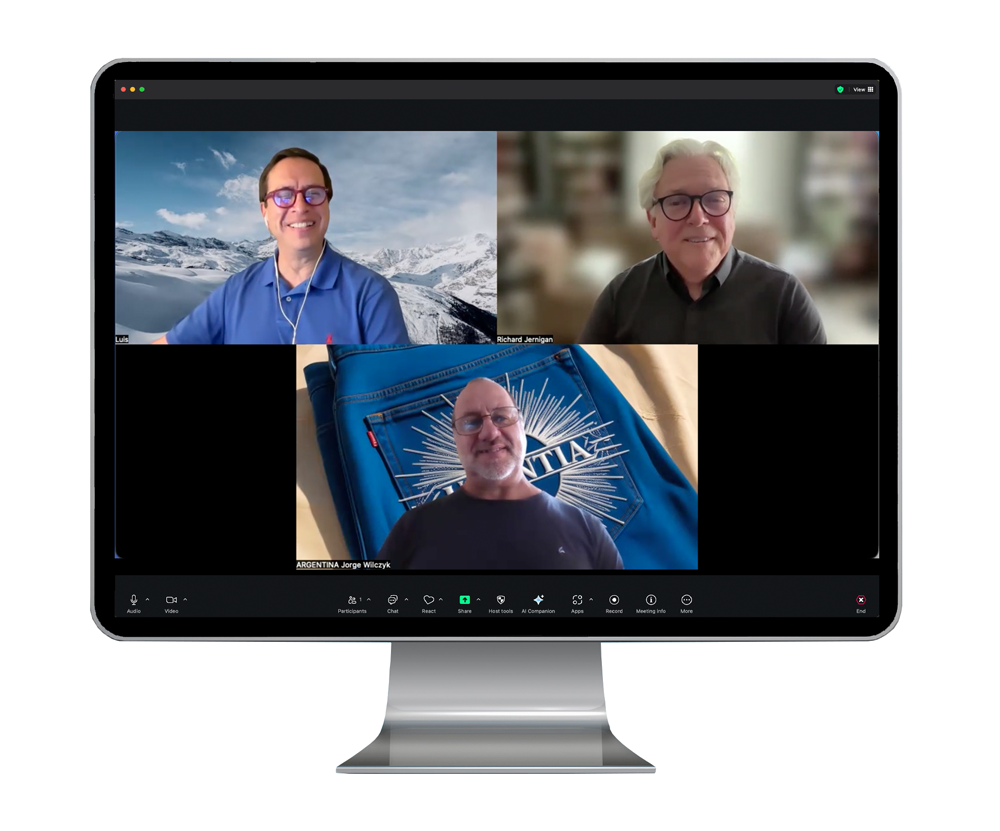
Editor’s note: the following interview with Jorge Wilczyk was conducted via Zoom by Luis Garcia-Bory and Richard Jernigan on April 16, 2026. The interview was conducted in Spanish and translated into English under Bory and Jernigan’s supervision.
LUIS: Jorge, it is a pleasure to see you and to be with you in this session today to understand something of your Urantia Book story, not only from your own perspective, but also in relation to the broader experience you had with clergyman Jorge Castelli. You mentioned to me earlier that you are a journalist by profession. Could you briefly share your professional background?
JORGE: Of course. I am a journalist by profession, and later I studied radio and television production to gain a broader perspective on the field. Around 1995, I began working in local television and later moved into the station’s news department. I was born in Vicente López, just outside the City of Buenos Aires, Argentina, and I was able to build a professional career in radio, television, and print media; in short, in all the areas that a journalist normally enjoys exploring.
LUIS: Tell us a little background about how you came to find The Urantia Book.
JORGE: Certainly. If I had to describe it, I would say that I was not looking for anything. I was baptized as a baby and, at the age of nine, more as a formality than anything else, because we were not practicing Catholics, I attended catechism classes.
In Vicente López, where I lived, you had to go to the church in your own district, where I lived, you had to attend the church in your own neighborhood; you could not go to another church to receive First Communion. I went for the first time with my brother, who is one year older than I am. The priest who was giving the introductory talk before the catechism class passed around a small bag attached to a long pole so that each of us could put some money into it. I had no idea how any of that worked; everything was new to me. None of us had any money. We were just kids. When the class ended, we felt very bad because the priest’s closing remark was: “And just so you know for next time, if you put less than five pesos into the collection before class, God gets angry.” Imagine that. That was my very first encounter with the Church.
We went home upset. We came from a very humble family; my father worked two jobs every day except Sundays. My brother and I told Mom and Dad what had happened. My father was furious. On Sunday morning, he went to the church to speak with the priest after Mass. “How can you say something like that to children?” The priest was a very arrogant man and simply replied, “I don’t know you, sir.” That response put my father in a bad mood. My father was an imposing man, about six feet five inches tall, and a former soccer player. So he replied, “How can you tell children that God asks them for money?” The priest began scolding him, saying that he had no right to speak to him that way because he was not a Christian, because he did not go to church on Sundays. My father replied, “God is everywhere. You don’t have to come to church to find Him. I don’t come because I work all week and I want to spend Sunday with my family.” The priest told him he was a bad Christian and that we did not deserve to receive Communion there. He spoke very harshly to my father. I no longer remember the exact words, but I do remember the scene because we were all there and a crowd gathered around. Eventually, my father had enough and pushed the priest. The man fell to the ground. It was a very tense moment and also a very unpleasant one for us. We were just kids. After that, my father apologized to us over and over again. From that moment on, we never received Communion, and my relationship with traditional religion practically disappeared. And forgive me for going off on a bit of a tangent, but after all, it is also part of my story.
But let me tell you how I came to The Urantia Book. Many years later, around 1995 or 1996, I was dating a physical education teacher. One day, at a gathering with her friends, who were also physical education teachers, I overheard someone talking in a group a few meters away. Even though there were a lot of people, I clearly heard him say that when Jesus died, a flying saucer came down, and that a cousin of his had read about it in a book called Caballo de Troya (Trojan Horse).
I heard the comment, but I did nothing with that information. About two years later, my girlfriend and I won an all-expenses-paid trip to Bariloche, in southern Argentina. When we arrived, the weather was rainy, so we went for a walk around the area near the hotel. As the rain became heavier, we stepped into a bookstore for shelter. While browsing, I noticed a pocket edition of Caballo de Troya 1 by J. J. Benítez among the discounted books. I immediately remembered the comment I had heard at that gathering. “This is the book Roque was talking about.” I bought it and started reading it out of curiosity. What hooked me was reading what Jesus said in those books. Over time, I read the first five volumes in pocket editions, which was all I could afford at the time. It was not the Caballo de Troya storyline itself that interested me. I would simply flip through the pages looking for the sections where Jesus appeared and read only what He said. Some time later, I went to a large bookstore in Buenos Aires to see if they had Caballo de Troya 6 in a pocket edition. The salesman told me: “No, I don’t have that one in a pocket edition, but the series is already well beyond volume ten. However, a few days ago someone came in and told me that Caballo de Troya is actually a copy of The Urantia Book.” That was the first time in my life that I heard the name The Urantia Book. I asked whether they had a copy. He spoke with the manager. They moved several things behind the counter, as if they were opening a safe, and brought out a corrugated cardboard box. Inside was a single softcover copy of The Urantia Book. I was surprised. Like many people when they see it for the first time, I thought it looked like a Bible. I opened it at random, read a passage about Jesus near the end of the book, and was deeply impressed. The price was far beyond what I could afford. It took me three months to save enough money. When I finally returned, I found a hardcover edition and bought that one.
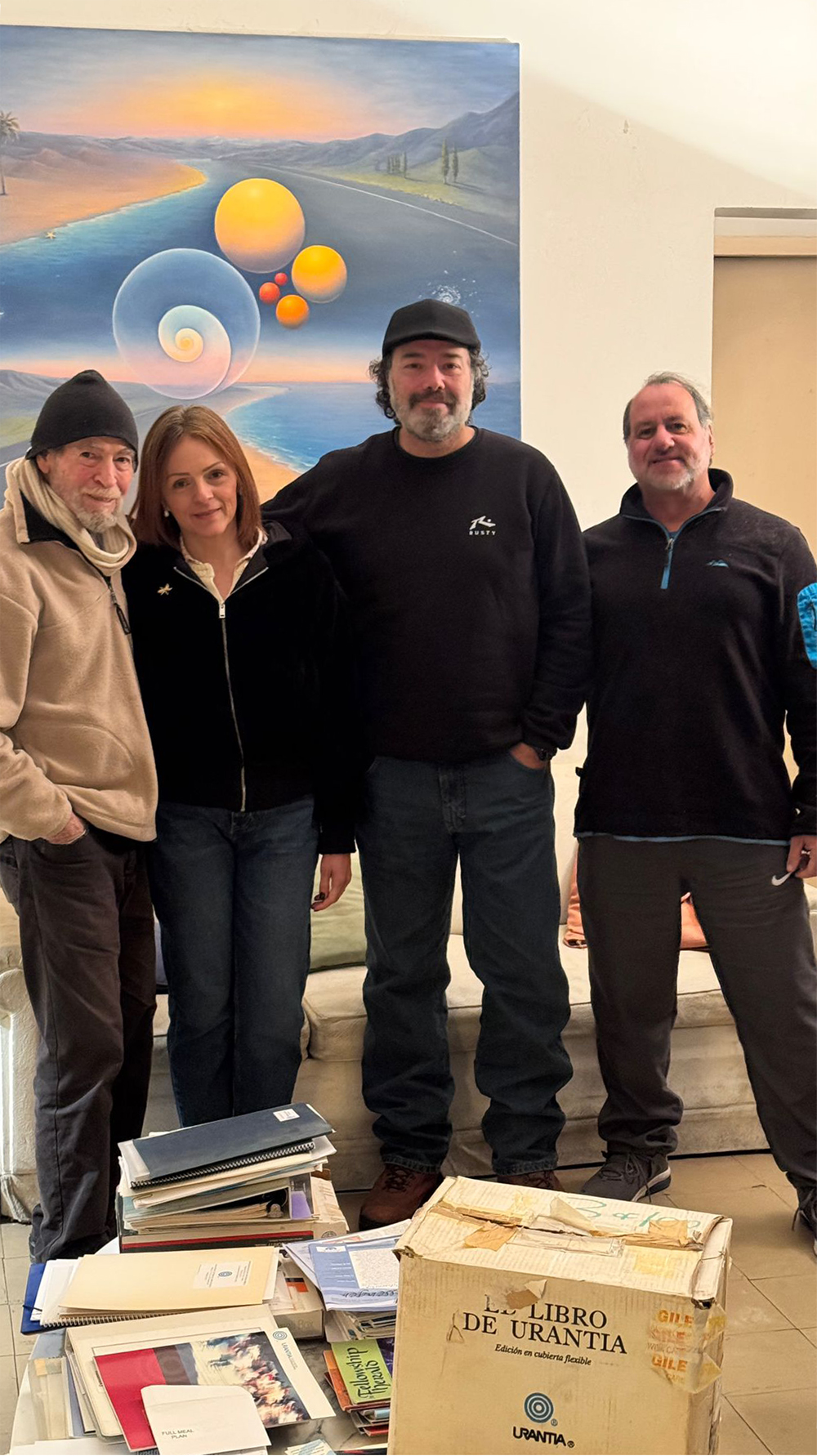
From then on, I began reading it and immediately started looking for other readers in Argentina. The internet was still very new, and the only things I could find were Urantia Foundation and a Southern Cone contact list that included Carlos Rubinsky’s address. There was no telephone number, only the address. So, with that address and knowing he lived in Buenos Aires, I looked up his phone number, contacted Carlos Rubinsky, and two days later went to his house. From then on, I continued reading and studying, and that was more than twenty-six years ago.
LUIS: That is a very common experience among those of us who first encounter the book through Trojan Horse. But beyond that initial approach to the papers concerning Jesus—how did you tackle the rest of the book?
JORGE: First of all, out of curiosity, one looks for similarities with what one already knows. In my case, what I had read about Jesus and what had moved me. The second thing that interested me in The Urantia Book was the concept of the Thought Adjuster. While reading Caballo de Troya, at one point Jesus speaks about “the divine spark within each of us.” The moment I read that, right in the center of my chest, it was as if something said, “Here I am.” It is a personal experience that is difficult to convey. If I had to describe it, it was like experiencing a light, a feeling, something very pleasant and difficult to put into words. That is why the concept of the Thought Adjuster immediately caught my attention and brought me closer to the idea of a God who did not ask you for five pesos when you went to catechism class.
LUIS: Several years later you had severe health concerns and had to undergo dialysis. But this also led to your friendship with the Archpriest Jorge Castelli.
JORGE: I had always been a very healthy and athletic person. I ran marathons. Without realizing it, I began developing mild kidney failure and, because of a diagnostic error, I was prescribed the wrong medication, which worsened my kidney condition. That eventually led me to dialysis in 2011. I was on dialysis for nine years, but I believe that, regardless of the difficult things that may happen to us in life, the important thing is always to do the best we can with the situation we are given. And that includes helping other people whenever possible.
To do good, you do not necessarily have to donate money to kids in Africa, although that is certainly a noble cause. In general, it was a very valuable experience, and my friendship with Jorge Castelli was part of that experience. It also gave me the opportunity to help and, when possible, support other people, especially those arriving at dialysis with completely understandable fears.
Dialysis is, in general, a very invasive treatment, and for some people it can be difficult. Three times a week, you spend about four hours connected to a machine. Two large needles are inserted into your arm. Blood leaves through one line and returns through the other. This whole process has a series of physical effects which, combined with each person’s own anxieties, including the very real fear some people have of needles, can affect blood pressure, cause dizziness, or even make someone faint.
Because of that, whenever a new patient arrived at the dialysis center, they would often seat them in the chair next to mine. The nurses and technicians would usually say, “Ask him. He’ll tell you what it’s like and help you understand what to expect.” It wasn’t the same hearing it from a doctor as hearing it from another patient who was also connected to a machine. So I would talk with them and try to help them feel more at ease. If a problem came up, I would explain that it was normal and that it could usually be resolved quite easily. I was also able to use that time to talk about many different things, including ideas from The Urantia Book whenever they were relevant, without ever mentioning the book itself.
LUIS: In your article, you mention that Jorge Castelli was an Archpriest of the Orthodox Church of Antioch. It is Christian, of course, but as an Orthodox body, it has certain distinctions. Did he ever speak to you about this Orthodox denomination?
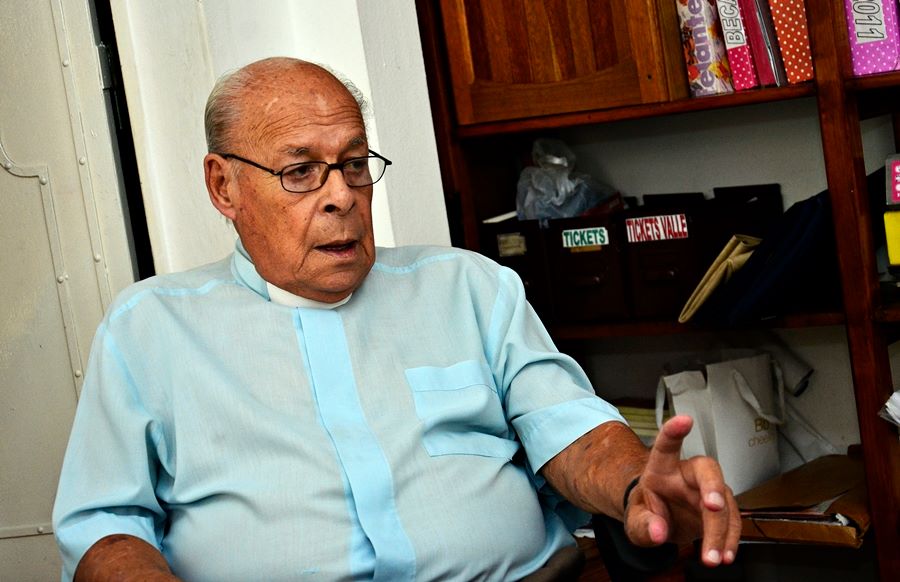
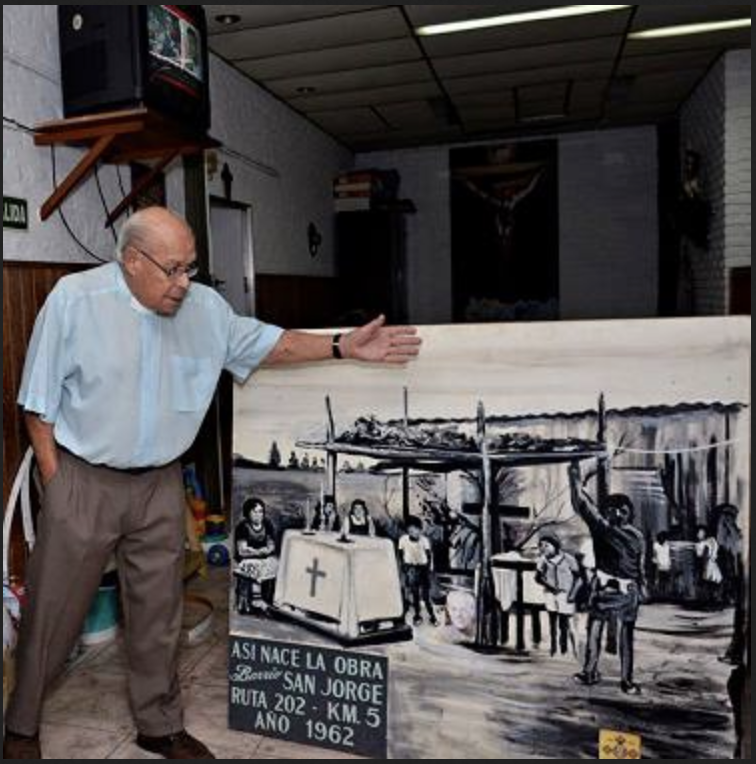
JORGE: In reality, my relationship with Jorge Castelli was never centered on the church to which he belonged. He was a strong-willed and very practical man who, despite his stern appearance, had a great sense of humor that would emerge from time to time. Regarding his academic background, he told me that he had studied theology at the University of Balamand in Lebanon. He never spoke to me about the particular characteristics of the Antiochian Orthodox Church, except to point out where its main church in Buenos Aires was located. What struck me most about him was his open-mindedness, especially in religious matters. Since I had very little religious background before discovering The Urantia Book, when I met him at the dialysis center I simply assumed he was an ordinary priest. The title “Archpriest” surprised me, mainly because I had no idea what it meant. What also surprised me was that his outlook did not fit the image I had of a traditional clergyman. The school he founded, and the entire institution he built around it, looked very much like the church-related schools we commonly see in Argentina. From what I observed when I visited, it was very similar, both in structure and appearance, to traditional Catholic educational institutions.
LUIS: It is my assumption that in a place like Argentina, where there are many Catholics, for someone like Jorge Castelli to become a parish priest in an Orthodox church would be extraordinary. So, the very fact that he chose that denomination and that vocation is itself intriguing. Just how much of his personal story did he share with you—specifically, how he came to join that particular denomination?
JORGE: He came from a traditional Argentine family, with roots going back to the May Revolution and with a relative who had participated in the First Junta. He was something of the rebel in the family, quite apart from his religious vocation. I can only assume that this independence of mind led him to seek a different perspective from the traditional religion of Argentina, which at that time was, of course, Catholicism.
LUIS: You told me a moment ago that what struck you most clearly was his open mind. The rebellious streak partly explains that. Rebellion itself is a way of opening horizons beyond the strict confines of a very conservative, traditional family. But was there anything more that made you realize he was open to hearing about The Urantia Book?
JORGE: Unlike most people when they begin reading The Urantia Book, he was impressed by the first part of the book. What struck him was the broader way in which the concepts of God and the different phases in which God manifests Himself are presented. Although theology certainly explores these subjects in great depth, he was surprised by the clarity of the early Papers. For him, it was like finding more precise definitions for ideas that had already been circulating in his mind but had not yet been clearly formulated.
LUIS: So, the two of you began a back-and-forth exchange during dialysis sessions. Tell us a little more about that experience.
JORGE: A dialysis session can be quite tedious. We sit in reclining chairs, and there are televisions available where, if you want, you can put on headphones and listen. In our case, we spent a great deal of time talking. Since we both had strong voices, other people often ended up listening to our conversations. Sometimes another patient would join in. Between serious topics, we joked around, wandered off on tangents, and then returned to whatever subject we had been discussing, but in general the conversations were very interesting. The usual joke among the patients was, “What’s today’s talk going to be about?” It was something along those lines. I should emphasize that Jorge was a strong-willed man and sometimes arrived somewhat worried. In fact, he often asked whether he could spend fewer hours connected to the dialysis machine because he had an enormous amount of work to do. He was deeply committed to everything he had built over the years. He had been working within that community since 1962 and felt a great responsibility toward it. As a result, there were times when he arrived with his mind completely occupied by those concerns.
During those hours, we talked about many different things. Sometimes about The Urantia Book, and other times about completely unrelated topics. Sometimes he would ask me questions, and other times I would ask him, “What did you think about this section?” “How do you understand this?” Since I do not consider myself an expert, I often say that I have more faith than knowledge, and sometimes that makes it difficult to express what I feel or understand, especially when speaking with someone who has formal theological training. Jorge Castelli was not only a good listener; he also expressed himself with great precision. Those conversations led to some very interesting discussions, including topics such as Adam and Eve. At times it was quite entertaining because people listening nearby would make jokes, add their own comments, and everyone would end up participating. One of the patients became interested in some of the topics we discussed and eventually asked me for a copy of the book.
LUIS: Did you tell other Urantia Book readers about these conversations you had with Castelli?
JORGE: The Buenos Aires study group that met weekly at Carlos Rubinsky’s home used to ask me, “What did you talk about with the priest this week?” At one point, Carlos Rubinsky and his wife wanted to meet him, so we arranged a visit. We went one Sunday afternoon. He gave us a somewhat inconvenient time, but explained that it was the only free time he had available during the entire week. He was a very busy man and deeply committed to everything he was doing within the community. I believe the appointment was around six o’clock in the evening. It was a very interesting conversation. I tried not to speak too much because I already spent many hours talking with him. What interested me most was watching the interaction between Jorge Castelli and María Inés, Carlos Rubinsky’s wife, who sadly has since passed away but who was also a reader and student of The Urantia Book. She came from a more traditional Catholic background, so they had many things in common. It was a very pleasant gathering. They got along almost immediately and quickly established a good connection.
LUIS: Moving on to the theme of Jorge Castelli’s own network, you indicated that it was quite separate from his institutional, ecclesiastical side. Did you ever have the chance to meet other clerics, people from his network of theologians or people of that profile, or was it something very separate?
JORGE: Sometimes he would say to me, “I’m going to share this with the group.” “What group?” I would ask. Then he would explain, “I belong to a group made up of people from other churches here in Argentina and from different countries throughout Latin America.” He would talk about them, but he was discreet when doing so. I suppose that, in general, people with religious or theological training tend to be more reserved when discussing these kinds of subjects. Several of them seemed to be open-minded, like Jorge, but they could not publicly express everything they thought because some of those ideas conflicted with the doctrines of their own churches. What united them was not their religious denomination but their interest in understanding and exploring theological questions more deeply. In that sense, The Urantia Book may have been a valuable contribution for many of them. There was an exchange of letters with some members, and there was also a local group that met in person once a month.
In practice, it was a study group where they discussed many of these topics. The Urantia Book was important to him because it complemented ideas that many of them had already been thinking about but had not yet managed to fully express or organize. I know there were people from the Catholic Church in Argentina. None of them were evangelicals. There were also participants from other Latin American countries. I especially remember Venezuela, although there were others from the region as well. I am speaking only from memory. I never kept any formal record of all that; I simply knew those details from Jorge’s comments.
What I do know is that he shared material from The Urantia Book with that group and that he later incorporated some of those ideas into what I believe was a training program for seminarians, or something along those lines. It had a specific name, although I do not remember it. The Orthodox Church was developing an educational program intended for use throughout Latin America, and he told me, “I’m going to use this with the seminarians whenever I can.”
LUIS: Were you able to gain access to any of those specific educational materials he might have prepared or shared?
JORGE: No. I never tried to obtain those materials, and most of what I knew came simply from occasional comments Jorge made to me. I did know that it was a new educational program being developed for use throughout Latin America, around 2012.
LUIS: It would be very interesting to investigate. Now, returning to Jorge Castelli and the person who was the connection to Pope Francis, how much were you able to learn about all those matters? Could you elaborate a little on that?
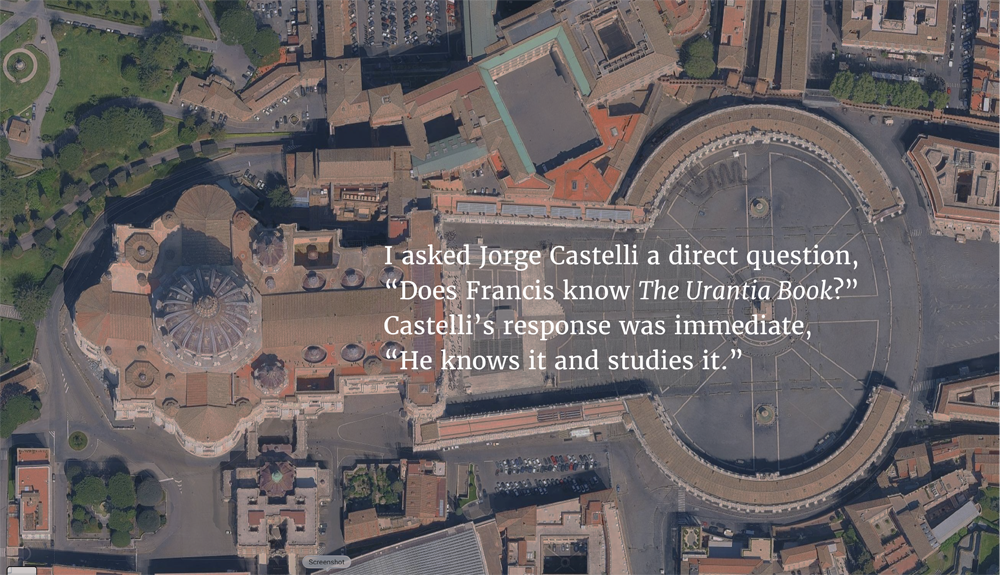
JORGE: Regarding this high-ranking figure within the Argentine Catholic Church, and knowing of his close relationship with Jorge Bergoglio, I asked Jorge Castelli a direct question, “Does Francis know The Urantia Book?” Castelli’s response was immediate, “He knows it and studies it. I know because I asked him…” and he mentioned the name of the other religious figure.
That was essentially the entire conversation. Castelli was very direct and clear. According to what he told me, the Pope knew the book and studied it. The answer surprised me. It is one thing to assume that copies of The Urantia Book may exist in the Vatican library or archives. It is something quite different to hear someone state that Pope Francis knew the book and studied it.
LUIS: That is why it was so very important for us to hear from you firsthand. We certainly understand that you cannot share the name of the high-ranking cleric within the Argentine Catholic Church, but what convinced you Jorge Castelli’s story was true?
JORGE: From a journalistic standpoint, this is indirect testimony that cannot be verified through multiple sources. However, my conviction is not based on that criterion but on my personal knowledge of Jorge Castelli. Although I did not mention it in the article because it was not relevant, I had the opportunity to work with Jorge on a documentary project about the development of his community. That allowed me to know him much better, to learn about his background, his way of thinking, and the kind of person he was. That personal knowledge is why I consider his testimony reliable. Based on my experience with him, I have no reason to doubt what he told me.
But beyond this particular episode, I also tried, in my own way, to get a copy of The Urantia Book into Francis’s hands. Let me explain. When I was studying journalism, one of my professors was Alicia Barrios, a well-known Argentine journalist. She had been a personal friend of Jorge Bergoglio long before he became Pope. A simple internet search will show many photographs of the two of them together. Since she traveled frequently to Rome, it occurred to me to contact her and ask whether she could deliver a copy of the book to Francis. We spoke on one occasion. Later, she became ill and was recovering from cancer treatment. We got back in touch in April 2024, and she told me that as soon as she was able to travel again, she would make sure the book reached him. Unfortunately, it never happened. I still keep a copy of that conversation. I would have liked it to happen because I was planning to include a personal note, or something along those lines, inside the book. Unfortunately, it never came to pass. I still keep a copy of that conversation. I would have liked it to happen because I was planning to include a personal note, or something along those lines, inside the book. That was the idea, at least. And I suspect some kind of response might have come back, because Francis was known for those informal habits he had. Sometimes he would pick up the phone and call people unexpectedly. At first they thought it was a joke, until they realized it was really him. That happened many times in Argentina in all kinds of situations. I would have liked it to happen. But in the end, it was not up to me.
LUIS: And that is wonderful because it speaks of his humility, inspired by the divine spark.
It has been a genuine pleasure, Jorge, to have the opportunity to talk. Is there anything you would like to end the session with you think we should know, that we did not ask, or something you would like to include?
JORGE: Perhaps what motivated my article was this specific and concrete piece of information: knowing that Pope Francis knew and studied The Urantia Book, and understanding why his words about truth, beauty, and goodness resonated so deeply with us. That was probably the first thing that caught our attention here in Argentina when we heard that speech. The connection was immediate. And although we do not know how much of The Urantia Book he may have come to know, incorporate, or use, I believe this brings us back to a fundamental idea: what matters is the content of the book, not the book itself. Sometimes those two things seem to be the same, but they are not. Personally, I am always attentive to what might be useful from the book for the person I am speaking with. I do not usually say: “As The Urantia Book says…” Instead, I share something I learned from the book that I think may be useful for that particular person. And if it truly helps them, very often the person ends up asking: “That’s interesting. Where did you get that? Where does it come from?” And then I answer: “Well, that’s a topic for another time.” The point is that I do not go around talking about the book itself. I talk about its content. And yes, Francis may have done something similar. I hope this can also serve as a useful form of dissemination: sharing ideas without attaching labels to them. I believe that makes it easier for the message to truly reach people. After all, I myself discovered The Urantia Book through Caballo de Troya by Benítez, and I did so in my own way. I do not know whether that was Benítez’s intention, but I think the name Caballo de Troya is appropriate precisely because hidden within its story are many ideas and concepts that come from The Urantia Book.
LUIS: A great allegory to close today’s session, Jorge! Thank you. It has been a genuine pleasure, Jorge, to have the opportunity to talk.
JORGE: Thank you, too.
Luis Garcia-Bory has studied The Urantia Book since 1993, beginning his discovery of the Fifth Epochal Revelation in his native Mexico. For over a decade, he has moderated a pan-European Zoom study group and meditation sessions in English from his home in Geneva, Switzerland.
Read Jorge Wilczyk’s story “Did Pope Francis Know The Urantia Book?